
 Ecology
After breaking through a meter-long layer of Arctic ice, an expedition sponsored by NASA found waters that are richer in important microscopic marine plants than any other oceanic area on the planet.
These studies are important in understanding the effects of climate and environmental change on the Arctic Ocean and its ecology. The expedition, which was organized back in 2010 and 2011, was called ICESCAPE (“Climate Impact on the Ecosystems and Chemistry of the North Pacific Ocean”). Scientists explored areas of the Beaufort and Chukotka Seas along the western and northern coasts of Alaska aboard the American icebreaker Coast Guard.
Using optical technologies, scientists looked at how the environment in the area had changed and also studied the marine biology, ecology and biochemistry of these regions.
“We've made a discovery comparable to finding Amazon rainforests in the Mojave Desert,” says Paula Bontempi, NASA marine biologist and head of biochemical programs in Washington. – We decided to organize an ICESCAPE expedition to confirm the data obtained by satellites observing the ocean in these places, although it was very difficult to get here.”
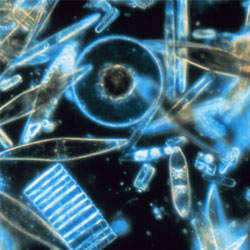
Microscopic plants or phytoplankton are part of marine food chains. It was believed that phytoplankton only grows in the Arctic Ocean when sea ice begins to recede in summer. Scientists believe that now, because Arctic ice has become thinner, this has allowed sunlight to penetrate it to the water, which has helped to create plants that were not seen here before.
In July 2011, researchers noticed water blooming under the ice in the Chukchi Sea. The plants grew at a distance of 115 kilometers from the shore under a crust of ice. These plants grow under the ice and do not travel to the open sea, where phytoplankton concentrations may be higher.
Phytoplankton was incredibly active, more than doubling daily. Plants on the high seas grow much more slowly, doubling in 2-3 days. This growth rate is the fastest among other living creatures in polar waters. Scientists have estimated that phytoplankton reproduction under ice in some parts of the Arctic may be 10 times faster than in adjacent open waters.
Fast-growing phytoplankton consumes huge amounts of carbon dioxide. Scientists have concluded that they will have to review the amount of carbon dioxide in the Arctic Ocean if it turns out that biological activity under the ice is common.
Scientists previously believed that Arctic ice blocks most of the sun's rays required for phytoplankton growth. However, over the past decades, ice in the Arctic has become much thinner. Young ice is almost flat, and the lakes that form on its surface when snow melts in summer are now much more common than on the uneven surface of old, thick ice.
These shallow lakes act as “ocean windows”, allowing plenty of sunlight to penetrate the ice and reach the water below it.
These marine plants previously unknown to scientists under the ice can be a problem for vast Arctic ecosystems that include migratory species such as whales or birds.
Small marine animals feed on phytoplankton, which are eaten by larger fish and other marine animals. Changing plankton flowering times can cause problems for larger animals that feed on either phytoplankton or living creatures that eat microorganisms.