
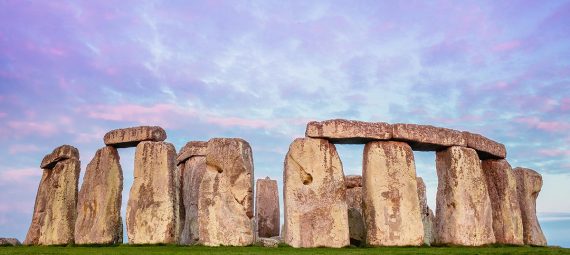
Stonehenge is one of the most enigmatic and mysterious prehistoric sites in the world. Located in Wiltshire, England, this ancient monument is made up of a series of standing stones that have been arranged in a circular formation. The origins and purpose of Stonehenge have long been the subject of debate, and many theories have been put forward to explain this enigmatic monument.
Archaeologists believe that Stonehenge was constructed in several phases between 3000 BC and 2000 BC. The stones used to build Stonehenge were quarried from several locations, some of which are over 200 miles away from the site. The construction of Stonehenge was an incredible feat of engineering and organization, and it is a testament to the skill and knowledge of the people who built it.
One of the most intriguing aspects of Stonehenge is its alignment with the movements of the sun and moon. The monument is believed to have been constructed to align with the solstices and equinoxes, and it is thought that the builders of Stonehenge were particularly interested in the cycles of the celestial bodies. This alignment suggests that Stonehenge was built for astronomical or spiritual purposes.
Another theory about the purpose of Stonehenge is that it was used for ritual and ceremonial purposes. It is thought that the stones were arranged in a specific way to create an enclosed space where rituals and ceremonies could be performed. Some experts believe that Stonehenge was used for healing ceremonies, while others believe that it was used for funeral rites.
Despite the numerous theories about the purpose of Stonehenge, there is still much that we do not know about this mysterious monument. One of the challenges of studying Stonehenge is that the people who built it did not leave behind written records, so we must rely on archaeological evidence and the interpretations of experts to understand its origins and purpose.
In recent years, new technologies have allowed researchers to gain a better understanding of Stonehenge. For example, ground-penetrating radar has revealed that there may be more stones buried beneath the surface than previously thought, suggesting that Stonehenge was even larger than we originally believed. Laser scanning has also allowed archaeologists to create detailed 3D models of the monument, providing new insights into its construction and design.
As we continue to uncover the secrets of Stonehenge, it is clear that this ancient monument remains one of the most fascinating and mysterious prehistoric sites in the world. Its construction and purpose continue to captivate the imaginations of people around the globe, and its enduring legacy speaks to the ingenuity and creativity of our ancestors. While there is still much that we do not know about Stonehenge, it is certain that this monument will continue to fascinate and intrigue people for generations to come.