
 Events
An 11-year-old boy from Russia recently stumbled across the remains of a well-preserved adult woolly mammoth, which was the first such discovery since 1901. The first such mammoth was found more than a century ago near the Berezovka River in Yakutia.
Zhenya Salider, whose Nenets family lives near a polar station in the northern part of the Taimyr Peninsula, found a frozen animal while wandering along the banks of the Yenisei River in late August. The mammoth was discovered 3 kilometers from the Sopkarga polar weather station. Zhenya immediately informed his parents about the discovery, and they informed the specialists.
“He smelled an unpleasant smell and saw something sticking out of the ground — it was a mammoth's back leg,” said Alexey Tikhonov, director of the Zoological Museum of St. Petersburg, who immediately arrived at the scene after the child's family informed scientists about the historical find.
The mammoth is perfectly preserved; its trunk, skin, eye and ear can be seen very well. Tikhonov said that the mammoth died at the age of 15-16 about 30,000 years ago. “The mammoth's meter-long penis was also not damaged at all, so it's safe to say it was a male,” the scientists said.
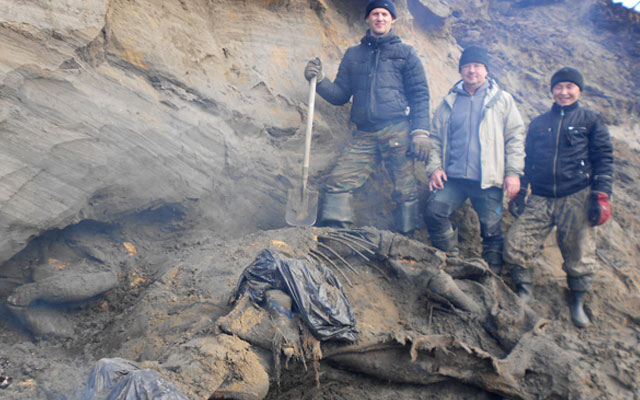
Tikhonov added that this adult mammoth was the first discovery of its kind in more than a hundred years. You could say that this mammoth is the mammoth of the century. It took scientists 5 days to dig up the mammoth using axes, hammers and even steam. The remains were then transported to the northern city of Dudinka, the center of the Taimyr Autonomous Okrug.
Despite the fact that it is not customary in scientific circles to name the remains of ancient adult animals, scientists still christened the mammoth “Zhenya” after the Nenets boy who discovered it. Officially, this animal was named Sopkarginsky mammoth, according to Tikhonov.
The total weight of the remains was 500 kilograms. The right half of the body with soft tissues, skin and hair, and a skull with one eye, a trunk and different bones have been preserved.
The mammoth was taken to Dudinka by helicopter and immediately placed in a refrigerator. Now we need to sign all the necessary documents with the local administration so that paleontologists from Moscow and St. Petersburg can start working with the remains.
Even an initial examination showed that the mammoth's hump consists of fat, as is the case with camels, and is not a skeletal structure at all.
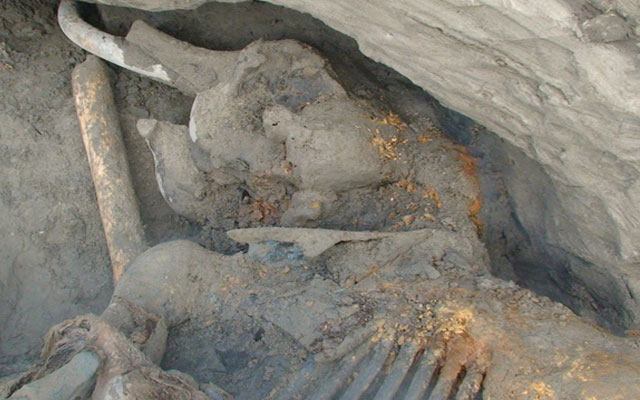
“This is the first time such a hump has been seen in paleontological images, and everyone wondered why a mammoth has this hump,” Tikhonov said. “It was believed that this was due to large dorsal bones. But it turned out that was not the case, and we saw that this animal was perfectly adapted to life in the north. He had plenty of fat reserves for the winter.”
After the remains have been studied, the mammoth will go to the Natural History Museum of Taimyr and become an exhibit in this museum.
Earlier it was reported that the Russian Academy of Sciences plans to clone a mammoth together with Japan's Kinki University, where scientists have been working on cloning prehistoric animals for the past 15 years years old. Scientists can use Indian elephants as a base rather than African elephants, since the DNA of these animals is closer to that of mammoths.