
 useful properties Useful tips
Every year, cold brew (or cold brewed coffee) is gaining popularity all over the world.
Why is this happening and how useful is this drink? Is there a difference between cold brew, cold coffee and nitro coffee?
It should be noted right away that cold brew and cold coffee are different drinks, although both drinks are cold and both are based on coffee.
Cold coffee is a drink brewed in the usual way, that is, hot water, but which is cooled and served with ice, cold milk or ice cream. Alternatively, you can freeze coffee in cubes and then add it to a glass, diluted with water or milk.
Before we start listing the advantages of cold brewed coffee, let's first figure out what cold brew and nitro coffee are.
What is cold brew

Cold brew is made from coffee beans, which are filled with cold water and left for 12-24 hours, depending on the recipe. It's not about water temperature, it's about time. It is after a few hours that you will get a sweeter drink with a richer palette of flavors.
Cold brew is much milder than regular coffee, which can be bitter. You can also not add sugar to it, as it is slightly sweet on its own.
Read also: Better than Starbucks: 10 cool homemade iced coffee recipes and their names
What is nitro coffee
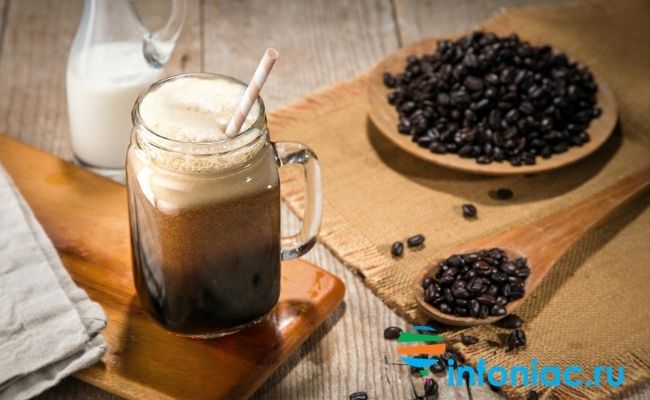
This drink is coffee brewed with nitrogen (literally). The coffee is placed in a beer barrel and served in a glass.
The drink takes on a creamier and sweeter taste. When you pour a glass of chilled nitro coffee, you get what looks like a serving of beer with a frothy cap.
This drink should not be mixed with milk or ice, otherwise it will simply cease to be nitro coffee. For this, some bars in the West can even make you persona non grata.
How to make iced coffee
Now let's see why cold brew is healthier than hot coffee.
1. Less bitterness and acidity
When we make cold brew, that is, we brew coffee without boiling water, the taste of the drink becomes softer and richer.
Extraction (extraction of substances) occurs when water dissolves and draws substances out of the coffee grounds. These can be sugars, acids, dissolving particles, oils, etc.
Different temperatures “draw” different substances at different speeds. For example, we usually say that the best temperature range for making hot coffee is 90-95 degrees.
The higher the temperature, the more bitterness. This is because high temperatures convert acids into bitter compounds. At 85 C, your coffee is likely to be too acidic. This is due to the fact that the water is not hot enough to dissolve the amount of non-acidic compounds.

When brewing cold brew, different rules apply. It is brewed for 12 to 24 hours, and cold water not only slows down the extraction of these compounds, but actually changes what is extracted from the grains.
Acids that usually turn bitter in hot coffee are not extracted. The result is a soft and refreshing taste.
Tests have shown that the acidity level in cold brewed coffee can be 66% lower than hot coffee, and this drink is also less bitter. Therefore, people with sensitive stomachs or acid reflux are better at digesting this kind of coffee.
As a rule, Arabica beans have a milder taste, and Robusta grains have a more bitter taste. But since the taste of cold coffee is milder, you can also use robusta, a less expensive type of coffee.
Read also: 10 things a barista won't tell you when ordering coffee
2. Cold coffee will save you time

After you have brewed cold brew, the extract obtained can last for a week, so you do not have to brew a new coffee every day.
When it comes to consumables, all you really need is a grain, a brewing container and a chosen filtration method. It could be anything from gauze to French press. You can even use a regular paper filter.
Busy people don't always have time to make the perfect coffee. When preparing cold brew, you simply mix cold water with ground grains and put the container in the refrigerator in the evening, and in the morning pour some of the concentrate into a cup or thermos and dilute it with water or milk.
Read also: 10 mistakes you make when making coffee at home
3. More caffeine
Due to the long brewing process, the ratio of coffee to water in the drink is approximately 1:60. In regular coffee, this figure is about 1:20.
However, remember that some people dilute this drink with milk, cream, or water, which reduces the caffeine concentration. In addition, there are several factors to consider:
• coffee beans you use
• the total time you brew coffee
• how much milk, cream, or water do you use to dilute the drink
The usual 500 ml French press in which you brew cold brew contains about 200 mg of caffeine.
4. Iced coffee is sweeter
Due to its lower acidity, cold brew is sweeter than regular coffee. During its brewing, the oils and acids that accompany hot coffee soften. The result is a more aromatic coffee that enhances the fruity, vanilla and chocolate notes of coffee beans.
Read also: 10 facts you haven't heard about instant coffee
5. Cold brew is a great pre-workout drink

Due to its high caffeine content, iced coffee can give you energy to exercise. By drinking cold coffee before a workout, there is a chance that you won't feel very tired after training and that you won't feel severe muscle pain.
6. Helps you lose weight
Due to its high caffeine content, cold brewed coffee can help you lose weight. By drinking a cup of cold brew or nitro coffee, you increase the so-called afterburn effect, that is, post-workout calorie consumption.
Regular coffee also has this effect, but it contains less caffeine, which means that the effect will be weaker.
Read also: What happens to your body if you drink coffee on an empty stomach every day
7. Improves brain function
The same caffeine in cold coffee increases blood flow to the brain, improving cognitive function. A study conducted on rats at the Human Nutrition Research Center on Aging showed that bioactive substances in coffee can significantly improve cognitive functions and motor skills.
Simply put, the more caffeine in the drink, the more your “brain” will pump.
8. The Elixir of Life

Some studies have shown that drinking coffee daily can extend your life. Why? The fact is that coffee increases the body's ability to burn fat, increases insulin sensitivity and reduces the risk of dementia.
The conclusions of most studies are based on the large number of antioxidants that coffee is rich in, especially chlorogenic acid.
It is believed that some antioxidants, along with oils and acids, remain in the drink after this brewing process, which means that cold coffee is not inferior to hot coffee in this regard.
9. Cold Brew is a more versatile drink than hot coffee
Hot coffee is rich in flavor and aroma and can be used to make several cold drinks, but it's not exactly what most people would find versatile.
But you can make a variety of drinks from cold coffee. After making cold brew, you don't get a ready-to-drink drink, but rather a concentrate that can be used with various other ingredients — water, ice, milk, ice cream, juices.
10. Cold brew leftovers can be used to make ice cream
Cold brewed coffee concentrate can be used to make coffee ice cream, coffee ice cubes to improve the taste of regular iced coffee, or for other sweet treats, such as coffee cakes. Even coffee smoothies can be made by mixing the concentrate with banana, milk, or yoghurt.
How to make a coffee smoothie