
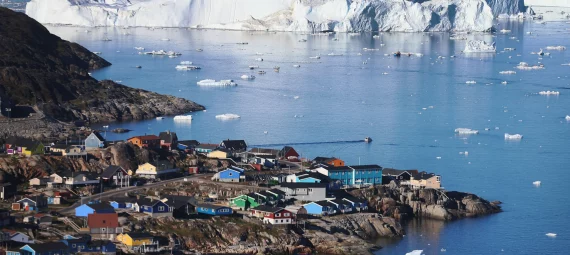
The ice island of Greenland pleases tourists with everything snowy: colossal glaciers, the brightest northern lights, igloo hotels and dog sledding. Whale watching and the tiny capital Nuuk, photos, map, tours and weather — everything about Greenland from the subtleties of tourism.
Greenland (Greenland, local name Kalallit-Nunaat) is the largest island on Earth, located northeast of the mainland of North America. The main “highlight” of tours to Greenland is the fantastic beauty of fabulous snowy landscapes. Accordingly, all the attractions here are somehow connected with the cold: be it igloo hotels, colossal glaciers or the northern lights. Whale bathing, amazing collections of the national museum of the country’s capital, or, to put it mildly, quaint local cuisine are just an addition. The capital of the region is Nuuk (Gothob).
It is most convenient to get to the island from Denmark. The national airline Air Greenland operates flights from Copenhagen to Kangerlussuaq (Kangerlussuaq, 4 flights per week in winter and 8 in summer) in the west of the country and Narsarsuaq (Narsarsuaq, 1 flight per week in winter and 3 in summer) in the south. The flight time to Kangerlussuaq and Narsarsuaq is the same — 4.5 hours.
The Icelandic airline Air Iceland (not Icelandair, namely Air Iceland) flies all year round from Reykjavik Airport to Kulusuk (Kulusuk, twice a week in winter and every day in summer) and Nerlerit Inaat (Nerlerit Inaat) in the east of Greenland. In summer, Air Iceland also flies to Narsarsuak and Ilulissat several times a week, and to Nuuk 2-4 times a week. The travel time to Kulusuk and Narsarsuak from Reykjavik is about 2 hours.
It is safe to travel in Greenland. The banal theft of a handbag is considered at least a sensation here. There is practically no risk of natural disasters such as earthquakes, volcanic eruptions or tsunamis in the country. There is also no street crime, at any time of the day or night you can move around local cities quite calmly. Still, it is worth following the usual precautions against pickpocketing and not leaving unattended photo and video cameras, mobile phones and other expensive devices.
Much more attention should be paid to your equipment and clothes. Even with a simple visit to Greenland, which does not involve trips outside the cities, you should stock up on warm clothes with good wind protection, as well as warm and sturdy shoes. If you want to take a ride in the tundra or in the area of ice fields, you need to consult with a local travel agency or operator about weather conditions and choose the appropriate equipment. Not to mention hiring a guide, stock up on drinking water, maps and a walkie-talkie, as well as warn the local tour operator or rescue services about your route.
When photographing on the territory of the country, ultraviolet filters, lens hoods and special lenses with illuminated optics are necessary. In winter, all photo and video equipment should be heated, treated with special lubricants that can work in the cold.
The climate of the coasts is marine, subarctic (south of 68 ° north latitude) and Arctic; in the area of the ice sheet — continental Arctic. Cyclones often cross the island, accompanied by strong winds, sudden changes in temperature and precipitation.
The average temperature of January on the coast is from -7 °C in the south to -36 °C in the north, in July — from +10 °C in the south to +3 °C in the northwest. In the center of Greenland, the average temperature in February is -47 °C (absolute minimum -70 °C), in July -12 °C.
The maximum amount of precipitation falls in the autumn-winter period, but snow can fall at any time of the year. In summer, thick fogs are frequent on the coast. Strong stock winds “peterak” blow from the expanses of the ice sheet almost all year round, the speed of which sometimes reaches 60-70 m/sec.
The best time to visit the country is during the polar “white nights” from May to July or for lovers of winter fun — in April.