
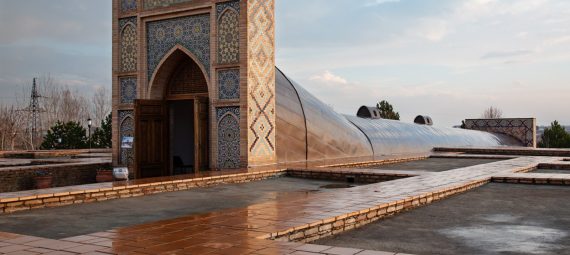
It is not by chance that Samarkand is called a real open-air museum. Once this glorious city was a powerful political, religious, cultural and, of course, scientific center. Local rulers and scientists made amazing discoveries here, some of which succumbed to “European minds” only after many centuries. In addition, Samarkand is known for its inimitable architecture with exquisite and intricate paintings. One of the main attractions, which combines architecture of rare beauty and reflects a rich historical and scientific heritage, can be called the famous Ulugbek Observatory.
The history of this ancient observatory and concurrently one of the main attractions of Samarkand is inextricably linked with the name of Muhamadd Taragai, better known as Ulugbek (from “great” — ruler and “bek — ruler”). Ulugbek, by the way, was the grandson of not just anyone, but the great and terrible Amir Timur (aka Tamerlane). Apparently, greatness was inherited from grandfather to grandson. And if Ulugbek’s ancestor loved to fight more and more, then his grandson showed an amazing craving for knowledge and education from early childhood. The young heir was particularly interested in the sciences called exact.
Muhammad was very lucky to have mentors, the best minds of that time were engaged in his training — the thinker and writer Arif Azari, the mathematician and astronomer Kazy-zadeh Rumi and other luminaries of that era. An important moment in the life of the future great ruler was the participation together with his grandfather in a campaign to Sultania, where an inquisitive young man saw for the first time an unusual structure — an observatory. Who knows, perhaps since then Ulugbek has cherished the idea of erecting his own house for stargazing?
Unfortunately, we are not destined to find out whether this was the case or not. However, immediately after the ascension of Muhammad Taragai to the throne, he orders the construction of this very observatory to begin. The main consultant during the construction of the grandiose structure was the teacher of the ruler of Kazy-zadeh Rumi. The beginning was laid in the autumn of 1420 and lasted about 3 years.
Finally, when the construction was finally completed, it was still necessary to install instruments for observing the star slope. This difficult and responsible task was entrusted to another prominent scientist — Jamshid Kashi, who later became the head of the Samarkand Observatory.
Ulugbek himself visited here quite often. He spent almost all his free time from state affairs within these walls. The ruler patronized scientists and tried to take part in various studies and experiments himself.
After the death of Jamshid Kashi, he was replaced as head of the observatory by Kazy-zadeh Rumi, who, however, also died soon after. Due to the workload of state affairs, Ulugbek could not spend much time at the observatory, and he even had thoughts of curtailing all observations, but the scientist Ali Kushchi dissuaded him from this. Alas, as a result of a cruel conspiracy in 1449 Ulugbek was killed. The observatory worked for about 20 more years, and after that the persecution of scientists began.
To this day, the observatory has not completely preserved its original appearance. According to the reconstruction, it had a cylindrical shape, reached a height of about 30 m, and a diameter of about 46. In its richly and exquisitely decorated walls there was a huge sextant with radii of 40.21 m, with which measurements of the starry sky were carried out. In the underground part of the observatory, the device is perfectly preserved. In 1964 not far from the location of the observatory, a museum named after Ulugbek was created, where you can see photos of excavations and ancient frescoes, among which there are those that depict some moments of Ulugbek’s life path, as well as excerpts from the famous “Astronomical Tables”, tools found in the observatory, and much more. In 2010, a monument to the great ruler was inaugurated in front of the museum.
Address: Tashkent Ave. (Toshkent yo’li), 1.