
 Ecology
We know almost everything we know about historical climate change through research into the cold northern regions. Polar ice and deep-sea sediments in the North Atlantic indicate global glaciation, changes in temperature and levels of greenhouse gases such as carbon dioxide. But scientists have always been interested in the question of what happened in the tropics during such climate changes. These important issues need to be addressed, as some of the climatic features of the tropics, such as the El Nino phenomenon, affect the entire planet.
Recently, scientists have begun to study hotter, lower latitudes in more detail. A new study of stalagmites in caves in northern Borneo has helped recreate the history of climate in the tropics of the Western Pacific between 570,000 and 210,000 years ago at the end of the Pleistocene period. Four ice ages took place during this period.
“Stalagmites are the ice sheets of the tropics,” says study author Jess Adkins, a professor of geochemistry at the California Institute of Technology.
Lack of indicators
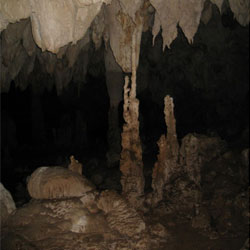
Water droplets that form stalagmites fall down to the cave floor, causing formations that contain different isotopes of oxygen to grow upwards. Isotopes of one element contain different amounts of neutrons in their nuclei. The ratio of certain isotopes tells researchers about the temperature in the ocean at a time when water dripped in a certain place in the cave, forming stalagmites. Thus, researchers are able to assess the climatic conditions of that time.
Throughout the history of our planet, the Earth's climate has gone through stages of global cooling, which led to the establishment of ice ages, which were followed by global warming, with which we are facing each other today. Adkins and his colleagues drew attention to the period between global cooling, about 430,000 years ago, when temperatures and carbon dioxide levels, as scientists know, rose by almost a third in northern latitudes.
Adkins and his team of scientists did not notice any particular changes in tropical stalagmites dating back to this time. “Stalagmites indicate ice ages, but warming is not as pronounced as high latitude data show,” Adkins said. “For the first time, we noticed that there is a difference in data in the northern regions and the tropics really do exist.”
Too much drought
However, some periods of climate change, both at high latitudes and in the tropics, are still visible. Scientists have found that too much drought in the tropics coincides with sudden climate changes in the North Atlantic at the very end of the ice ages. Scientists believe that these rapid changes were due to huge blocks of ice that sank into the oceans.
“The stalagmites show that there was a serious drought during this period,” Adkins said. “We believe that the tropics at that time faced events similar to El Nino that caused the drought.” (El Nino is a climatic phenomenon associated with above average temperatures in the tropical Pacific Ocean.)