
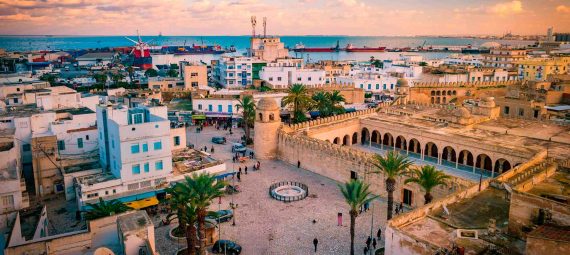
A mixture of Roman ruins, French colonial architecture and the flavor of Arab Africa, seasoned with the warm waters of the Mediterranean Sea — that’s what Tunisia is. And, of course, excellent thalassotherapy, for which the country can be forgiven some imperfections. Tunisia will become a breath of fresh air after the Turkish and Egyptian resorts have been surveyed along and across, and the impressions of the vacation will remain twofold in a good way. This is not a free Europe and not the orthodox East, but somewhere between two civilizations that came into contact in ancient times and peacefully coexist to this day.
Sousse
Sousse specializes in cheerful youth recreation. There are plenty of discos and nightclubs, restaurants and bars literally at every turn. The view of the city is quite European, except for the old quarters of the Medina and the surrounding fortress walls. And the port with snow—white yachts standing in a row is generally a sight and a spectacular background for photos. In Sousse and its suburb of Port el Kantaoui (in fact, an independent resort area) there is a large selection of 3-5* hotels, two water parks, 4 casinos, dozens of shops. In short, a good set of tourist joys. And the beaches fully meet the expected “standards”: white sand and smooth rows of sunbeds under straw canopies.
Of the significant sights that are definitely worth a look: the ancient Ribat fortress and the Grand Mosque, built in the 8-9 centuries and preserved their original appearance. It is no coincidence that local guides often include Sousse in their tours of Tunisia.
Monastir
From the ship to the ball, or rather, from the plane to the beach — this is about Monastir. There is an airport here, from where tourists travel to the resorts. Some hotels are really located a couple of hundred meters from the runway — very convenient, although not without disadvantages. One of the important advantages of local hotel complexes is a large territory with swimming pools, sports fields and tennis courts.
Each hotel has its own beach area, which is monitored by staff. There are many such establishments in the urban area of Skanes. Although the infrastructure there is weak and you will have to go closer to the central part of Monastir for entertainment, it is especially in demand among foreigners.
Hammamet
Hammamet has two opposite hypostases. On the one hand, it is a respectable resort, highly appreciated even by fastidious Europeans. The best tallas centers in the country are open here, local beaches are considered more well-groomed than those of competitors. You can safely come here with children — the hotels have fixed sections of the coast, there are play areas and water slides. On the other hand, Hammamet is not inferior to Sousse in terms of nightlife, so young people will not get bored either.
Yasmin Hammamet district is the center of worthy “fours” and “fives” stretching along beaches and long promenades. The rooms offer a magnificent view of the Mediterranean Sea and the port, where hundreds of yachts and pleasure ships are moored.
Tunisia
People go to the capital not for a beach holiday, but for impressions: the burning flavor of oriental bazaars mixed with classical European architecture and the labyrinths of narrow streets of the Medina, over which stone minarets tower. But the most important thing is the once great Carthage, which has been lying in ruins for many centuries, and the charming blue—and-white Sidi bou Said. As a rule, a couple of days is enough for a cursory acquaintance with the historical heritage of the city of Tunis.
Gammart
Quite another thing is the prestigious suburb of the capital Gammart. It is designed for the sophisticated public, accustomed to high standards of service. Hotels here are adjacent to private residences of the privileged class of Tunisia. There are few hotels, all without exception fully justify the 5* assigned to them. The sandy beaches of Gammart are wide and long, with rare rocky inclusions. There are usually few people on the coast, no one will prevent you from indulging in blissful idleness to the accompaniment of the measured noise of the waves.