
 Technologies
German researchers have turned an optical device into the world's first “nano-ear” capable of detecting sounds six frequencies below the human hearing threshold. Researchers believe that using gold nanoparticles as an eavesdropping device, they will be able to detect sounds emitted at the bacterial level.
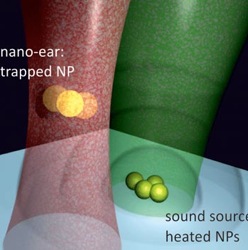
When creating a nano-ear, scientists relied on technologies used in laboratories for decades. An optical tweezer is a laser device that uses light to capture or manipulate small particles at a specific point in space. By trapping nanoparticles in such an optical trap and measuring the effect of different sound waves on these particles, scientists have found that they can “listen” to very small vibrations.
This means that sound is analyzed at an extremely low level. Gold nanoparticles themselves are only 60 nanometers (that's 60 billionths of a meter, which is about a thousand times smaller than a human hair), making them very sensitive to very small forces. The researchers used both “loud” sources – a tungsten needle glued to speakers that vibrate at about 300 Hz, and another source consisting of bunches of other nanoparticles, heated by a second laser and vibrating at only 20 Hz.
The Nano-Ear could hear both clearly. Sound waves pushed nanoparticles in the same direction in which the waves propagated, making it possible to accurately measure sound depending on the movement of the particles. Experiments have shown that a nano-ear can detect vibrations up to 60 decibels, or six frequencies lower than the human ear can hear. The device can be used to identify microorganisms or processes at the microscopic level or assist in the development and configuration of micro-electrical mechanical systems, scientists are sure.