
Every spring is a great reason to go out for a walk. The reviving nature gives a feeling of happiness, gives hope. Immaculately decorated parks, gardens, vast wild meadows are a real paradise for those residents of Germany who spend most of their lives in the shackles of the stone jungle.
Sanssouci Park, Potsdam
It is difficult to surpass the splendor of the territory of the Sans Souci Palace. A 2.5-kilometer-long embankment connects the main building with the obelisk, and the park stretches in both directions.
A baroque flower garden, shady lawns, carefully manicured hedges, thousands of fruit trees, colorful flowerbeds create endless lush landscapes. In 1990, UNESCO recognized the park as a World Heritage Site.
The star of the park ensemble is the palace, which was built in the middle of the XVIII century by order of Frederick II (the Great). Another interesting object is the tent room in the Charlottenhof Palace, designed on the model of the Roman tents in which the generals lived. The aesthetics and philosophy of the former residents of these palace grounds can be found almost everywhere: elegant architecture, fountains, more than a thousand sculptures.
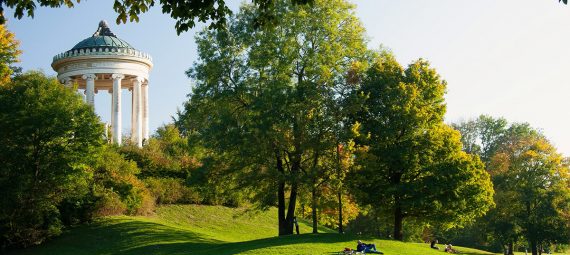
English Garden, Munich
The English Garden often tops the list of the most beautiful, popular parks, if you had the pleasure of walking along the park trail on a sunny day, you know why.
The English Garden with its vast meadows, winding streams, gardens is the perfect place to relax, escape from the hustle and bustle of the Bavarian capital. The great maestro Friedrich Ludwig von Skkell, the creator of this beauty, perfectly designed the “nature” here, the garden looks quite natural, little like a city park.
But a lot of work has been done there. The territory that was allocated for the English Garden was part of the river valley, where willows and sea buckthorn grew. First, a dam was built to prevent flooding. The further transformation of the site under Rumford’s leadership was an achievement that cannot be overestimated. In a very short time, trails were laid, trees were planted, bridges and buildings were built.
Island of Flowers, Mainau
From spring to late autumn, the island of Mainau in Lake Constance is an oasis of flowering plants. Roses, sunflowers, along with rhododendrons, are the first to show fascinating colors, followed by tulips, daffodils, and then dahlias, which bloom until mid-October.
Among the real treasures are rare trees: a bizarre Japanese pagoda — a tree that is about 150 years old. The graceful silhouette of the park is given by mighty oaks, proud cedars. In addition to palm trees, giant sequoias, bamboo, here you can visit a magnificent Baroque palace, a wonderful church, a butterfly house, as well as many restaurants that are open all year round.
Planten un Blomen, Hamburg
Of all the parks and gardens in Hamburg, Planten un Blomen is the most beautiful. This area was once home to a zoological garden, but in 1930 it was rebuilt, and then expanded several times.
Today, the park areas occupy approximately 47 hectares, are thematic sections:
- Japanese garden. It was designed by architect Yoshikuni Araki (1988). The emphasis is on the lake, on the shore of which the original Japanese tea house is located. Traditional tea ceremonies are held here from May to September. Any guest or traveler can participate in master classes in the following areas: Japanese calligraphy, Taiko drums, Japanese perfume ceremony.
- The rose garden. Designed in a classic style. There are about 300 different varieties of roses, including park, wild, climbing roses or tea hybrids. The ensemble is complemented by arches, recreation areas.
- Tropical house. The complex is divided into 5 zones, where plants are grouped by habitat.
There are quite a lot of entertainment in the park: several playgrounds, skate parks, a mini golf course, and in winter – an ice rink.
Azalea and Rhododendron Park, Kromlau
Being one of the largest German parks where azalea and rhododendron solo, Kromlau Park turns into a blooming sea in spring. In fact, this is an example of a classic English garden. This splendor was made in the middle of the XIX century by order of Friedrich Herrmann Retschke.
Rare woody plants, mythological and Rococo statues, basalt caves are not the only park soloists. Friedrich built a hunting lodge, surrounding it with a variety of flowers.
All tourists should take a look at the myth-covered “Devil’s Bridge”, which has not left the lists of the most popular places in Saxony for 1.5 centuries. The bridge is decorated with thin basalt spires. The parabola of the bridge is designed as an ideal hemisphere, so with still water and the right light, a visual illusion of a stone circle is created. Today it is forbidden to cross the bridge, but it is quite possible to see it up close.