
 Culture
Have you ever wondered why so many people love Olivier salad so much? And why is this particular dish so popular in the former USSR, associated with New Year's celebrations?
And after all, even those who hate Olivier are well aware of the peculiar sacred significance of this salad for almost everyone who loves the New Year holiday (that is, for the majority) .
The special status of Olivier salad as a festive dish has been perceived by us as such since early childhood. And it seems like it's always been like this. In fact, Olivier's popularity in our country is a vivid example of a kind of random product placement.
Where did this dish even come from? Much has been written about its origin, but most stories
look too artistic, raising many questions.
So how did “bourgeois” salad get into the life of almost every citizen of the former USSR? Why did Olivier salad become the most favorite New Year's dish for many millions? Let's start things first.
Content:
Who invented Olivier's
first salad
Interesting facts about Olivier
How to cook Olivier: 12 recipes for each month of the new year
History Olivier
Who Invented Olivier
The birth story of Olivier salad usually begins with the story of the birth of a man, a great hereditary cook. And that person was a certain Lucien Olivier. It is believed that Lucien was born in Moscow sometime between 1837-1838 (nothing is known about the more accurate date of the birth of the future “father of Olivier salad”).
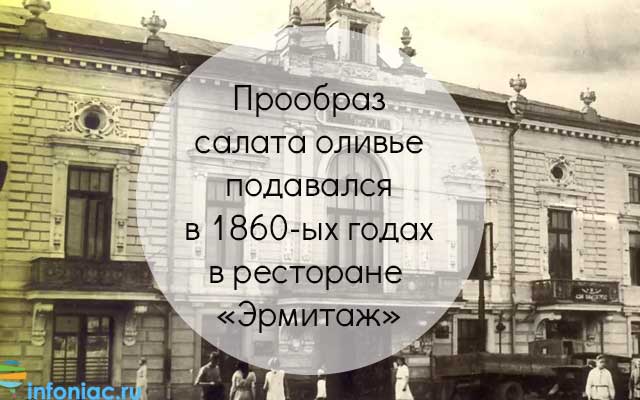
Sources that mention Lucien Olivier's name usually take us straight to the mid-60s of the century before last, when wealthy Muscovites and visitors to the city paid attention a restaurant called “The Hermitage”.
It was in this restaurant that visitors first tasted the prototype of Olivier salad, named after the supposedly hereditary chef (and part-time manager) of this establishment, Lucien Olivier . But that's where the first questions come in.
There is no evidence that Lucien Olivier was a hereditary cook
You might be surprised, but there are no reliable sources that would confirm that the restaurant manager Lucien was a great chef (and hereditary, as you can read in some.” historical” studies), does not exist.
What do we even know about Lucien? It is believed that the man was French or Belgian of French descent. However, we also face the same problem here: no matter how hard you try, you will not find a reliable source of this information (and many enthusiasts and historians have been purposefully doing this).
And what do the Moscow archives say about people with the surname Olivier who lived in this city at that time? It is known for certain that the address book of 1842 mentions only one Olivier, who was then living in Moscow. Perhaps his family gave birth to a “great cook”?
This is unlikely. The probability that four-year-old Lucien, the future creator of the super-popular salad, grew up in the family of this Olivier, a merchant and hairdresser owner named Ossip, at that time: although Osip had four children and three of them were boys, none of the children were suitable either by age or by name.
Was there even a man named Lucien Olivier?
We owe much of the fragmentary information we have about Lucien Olivier as the manager of the Hermitage Restaurant to such a person as writer Count Vladimir Gilyarovsky. And it would be possible to refer to his information if not for one “but”: Gilyarovsky was once called nothing more than a collector of urban legends. Legends and rumors.
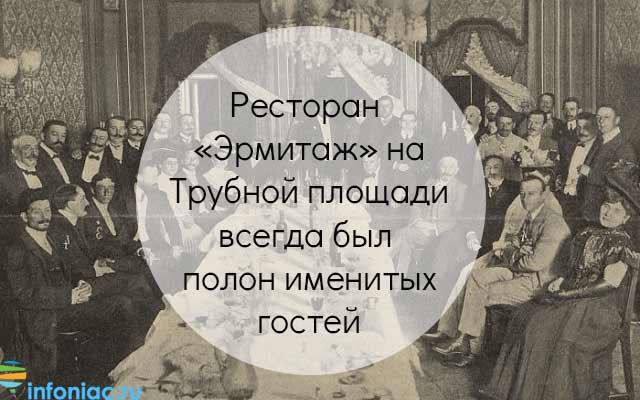
And yet: according to the same archival sources (which are the most reliable), the Hermitage restaurant, which opened in the chic Hermitage Hotel on Trubnaya Square in Moscow, like the hotel itself, they were run by someone… Nicolas Olivier. Another Olivier? Where did he come from?
Read also: What do different countries eat at Christmas?
Nikolai Olivier was first mentioned in 1868 in a kind of Moscow guide to hospitals, shopping stores, various enterprises, educational institutions, moneylenders, as well as hotels and restaurants.
However, in a list published in 1868, of persons who received the so-called Merchant's Certificate
(quite an official document!) , Lucien Olivier is the manager of the Hermitage Hotel.
Who was the first to talk about Lucien Olivier as a cook?
Writer Gilyarovsky, in his descriptions of the everyday life and traditions of Muscovites of those years, described the Hermitage establishment as a very popular and elite place. And it was he, Vladimir Alekseevich Gilyarovsky, who painted the talents of chef Olivier, who allegedly prepared an exceptionally delicious salad that made Lucien popular throughout Moscow.
Gilyarovsky, of course, could not see this personally, as he was born only in 1855; his book “Moscow and Muscovites” was published in 1926. And here's the most interesting part: there are simply no other sources of information we would learn about Lucien Olivier as a talented hereditary cook.
However, Lucien, the manager of the Hermitage, existed, obviously, as Nikolai, who changed his name to a more French one. Why? Maybe to match the “Frenchness” of the restaurant itself. One can only guess about Nikolai (Lucien)'s motives, since the man died in 1883, leaving almost no data behind.
Could the hotel and restaurant manager personally prepare meals at the restaurant of the hotel he manages? Hypothetically, this possibility is not ruled out, but there is no evidence of this fact, except for the existence of a beautiful legend about the hereditary chef Lucien Olivier (and many speculations based on based on this legend), we do not have it. But we have Olivier salad.
Real Olivier recipe
Olivier's first salad
The question immediately arises: maybe there was no Olivier salad at that time? It was, although the story of Olivier as a salad is no less confusing than the story of Lucien Olivier as a cook. There were many delicious dishes that the sophisticated Moscow noble audience really tasted for the first time at the Hermitage restaurant in the hotel of the same name.
By the way, another Russian writer, Pyotr Dmitrievich Boborykin, who lived at that time and visited the Hermitage restaurant, sincerely admired the incredibly huge cuisine of this establishment in his articles published in a popular monthly magazine. A French manager, allegedly born in Russia, was also mentioned there.
At the same time, according to Bobrykin, insisting on this information, about six dishes were worked on creating dishes in the kitchen of the Hermitage restaurant, which hosted all the nobility not only in Russia but also throughout Europe dozens of cooks. Did it also make sense for the hotel manager to stand at the stove?
But let's get back to the salad, or rather to its prototype!
The Hermitage restaurant served a very tasty and varied dish (perhaps really a salad), which was later named after the restaurant manager. Perhaps it was called that right away, on the restaurant's menu, although there is no indication of it.
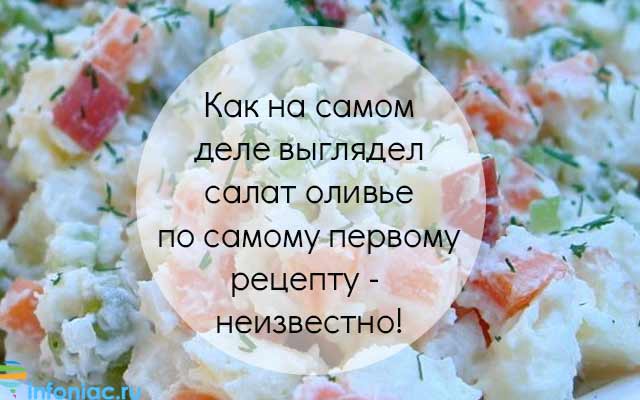
What the first recipe for this dish looked like, whether it even looked like a salad is unknown! Everything else you can find about Olivier salad linked to the Hermitage restaurant is stories, legends and speculations.
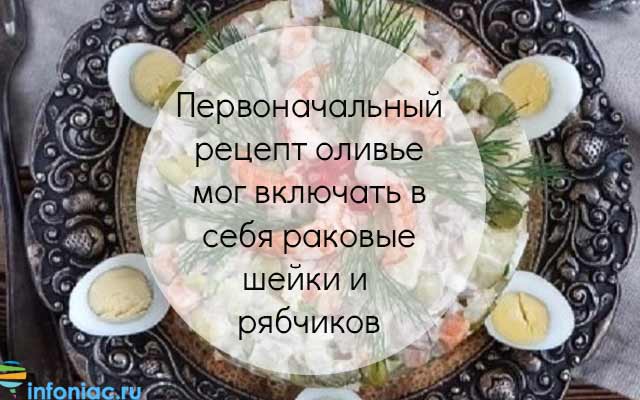
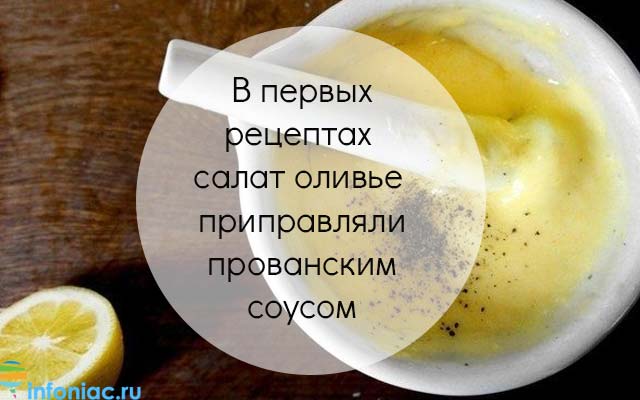
One such legend says that the restaurant's chef (according to the same legend, Lucien Olivier was the cook) presented his new culinary masterpiece, which was not a salad at all. Rather, it was a kind of ensemble of various products, generously sprinkled with Provencal sauce. The dish allegedly included crayfish necks, partridges, hazel grouses, lanspig, veal tongue and much more, including separately presented potatoes and eggs.
Some of these products are actually used as ingredients for modern Olivier salad. But, according to legend, visitors to the Hermitage did not appreciate the exquisite taste of the artist and maestro Olivier, mixing all the ingredients together. And the next day, the cook, upset by the public's ignorance, served the same dish, but in a mixed form. Like, that's how Olivier salad came about.
I would like to believe in this memorable legend, but there is one caveat (at least): the dish itself was supposedly called “Game Mayonnaise”. However, cookbooks from the middle of the century before last present us with a lot of dishes made from pork, beef, hare, and other living creatures under this name. It seems that mayonnaise became the sauce later.
Where did Olivier's original recipe go?
After Olivier's death, the Hermitage restaurant was repeatedly renovated, completed, rebuilt, and then finally closed in 1917. Have any recipes been lost? This is obvious. Was the recipe for that famous Olivier salad among them? As you know, there are no direct indications of this. But the story didn't end there, it just started.
Since 1884, recipes that are supposedly a reference to the “same” famous recipe
popular among the nobility of Moscow and visitors to the city of Olivier salad. The recipes changed from edition to edition and from publication to publication.
The authors of each subsequent recipe could make changes to the “original” recipe, replacing, for example, hazel grouses with chicken, recommending Provencal sauce. By the way, standards for mayonnaise, as a sauce we are used to, called Provencal, were already developed in the Soviet Union. By the way, there were no preservatives in it, except for alcohol vinegar.
Needless to say, among recipe writers, as well as among publishers and editors, there were many not the most talented people who expected, first of all, to make money? Without really trying to find any historical truth, some even invented the ingredients of the “first Olivier” (adding, for example, black caviar).
New Year's table salad
Soviet Olivier
The fame of Olivier salad as “a unique dish with incredible taste and nutritional qualities, the recipe of which has been irretrievably lost”, simply could not fade into oblivion. And it didn't sink. In well-known restaurants in the Soviet Union, many cooks tried to speculate (in a good way) on the long-standing fame of Olivier salad.
This can be called speculation purely arbitrary, since the chefs of the establishments sincerely tried to prepare something close to the original source (at least close to what was published in the old ones pre-revolutionary culinary publications).
Ideologically correct Olivier
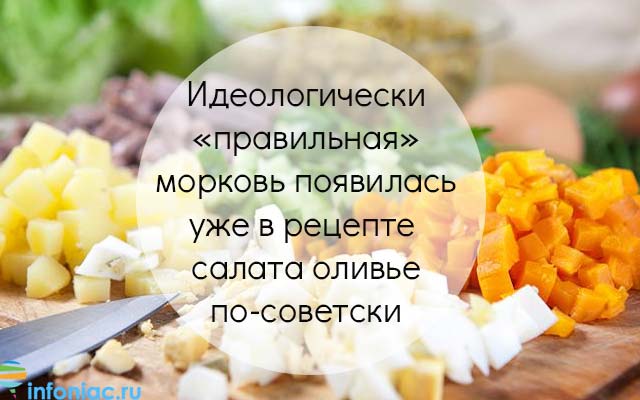
It is known, for example, that in the mid-30s of the last century, some restaurants in the capital served a la Olivier salad no longer with expensive ingredients, echoes of the bourgeois past (take if only the same hazel grouses!) , but with ideologically verified red carrots. And it was called “Capital”.
Perhaps the story of “ideologically verified” carrots is also a legend, and the chefs simply had to try new ingredients, including green peas instead of capers. And the sausage that appeared in the dish was the result of attempts to reduce the cost of the final product.
I must say that by that time Olivier salad was already known under several names: “Russian salad”, “Winter”. Again, “Stolichny”. There is no clear justification for this. You can find fabrications that “Russian” differs from “Olivier” in that one uses meat and the other uses sausage.
However, there is no logic in this, given the previous narrative. Most likely, the Soviet catering system tried to avoid the not quite popular name “Olivier”, trying not only new ingredients, but also new names. As we can see, one, the second and the third have taken root. There are even names like “Game Salad”.
How did Dr.'s sausage come from Olivier?
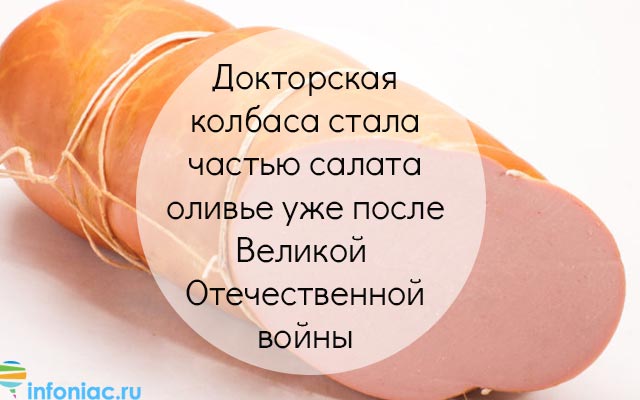
After the end of the Great Patriotic War, the Soviet people actively rebuilt the destroyed country. But even in the midst of harsh everyday life, sometimes I wanted to arrange a party for myself — with festive dishes and drinks. Olivier suddenly became an attribute of the celebration. But since chicken fillet was expensive, cheaper doctor's sausage was used everywhere.
In addition, this boiled sausage, developed back in 1936 as a dietary element recommended for those who have undermined their health as a result of the Civil and First World War II, it was recommended to citizens even after the end of the Great Patriotic War.
Read also: How to cook Olivier: 12 recipes for each month of the new year
In those harsh years, there was no time for holidays. However, the only holiday that our people could not afford to miss was the celebration of the New Year. It is not surprising that it was on December 31 that this most notorious attribute of festive life — Olivier salad — began to appear on the tables of millions of our descendants.
In addition, the ingredients used for this salad were quite available at this time of year – the same pickles and canned green peas instead of olives and capers, potatoes, carrots, eggs and stuff. It is highly likely that it is for this reason that the supposedly French Olivier salad was called “Winter”.
French Olivier
Interesting facts about Olivier
A thorough study of the issue, with a deep dive into historical details, destroys the aura of nobility and mystery that has been created over many decades over Olivier salad. But this does not cause Olivier to lose its popularity as a festive New Year's dish.
However, given the fact that most people do not bother with such research, there is no doubt that Olivier will forever remain a dish according to the restored recipe of the most famous French chef Lucien Olivier. By the way, many people call Olivier a French salad.
Do French people eat Olivier?
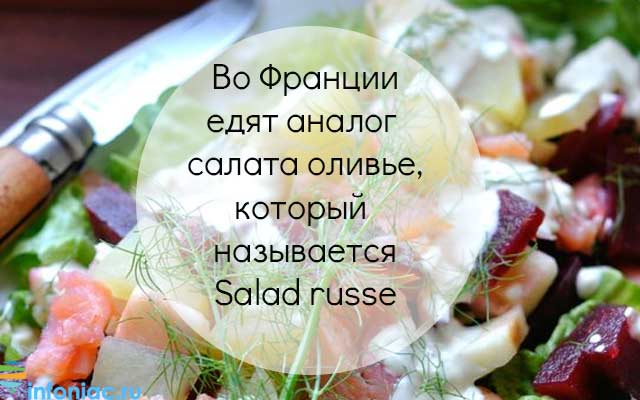
You can actually find Olivier in France. But not everywhere — that is, in some restaurants and shops. Most likely, these will be restaurants with international cuisine or Russian restaurants. And this salad will be called there (with a high degree of probability!) nothing more than “Russian salad” (Salad russe).
Of course, it does not cause any associations with a festive or New Year's dish among the French. However, an analogue of Olivier, in one version or another, can be found in almost any country. How does it look like our salad? Most of the ingredients. This salad may not even be called “Russian”, but just be some other salad.
It may contain boiled potatoes, eggs, onions, and even mayonnaise; however, the ingredients may be completely inappropriate in size — large pieces, eggs cut in half. And even if you find something very similar to Olivier, such a terrifying little thing as pickles will “kill” the feeling of homeland even in the most unbiased eater!
Olivier index
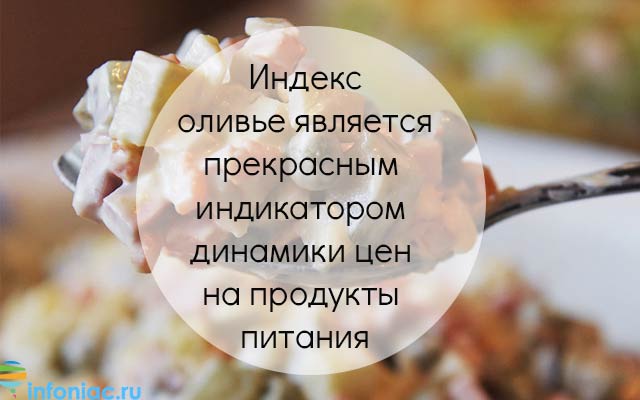
Perhaps you are the kind of person who is well versed in the notorious Dow Jones indices and all other stock indices. However, do you know anything about the Olivier Index? For those who don't know, such an index does exist. Frankly speaking, many statistical agencies can envy his accuracy in assessing inflation in the countries of the former USSR.
How the Olivier Index is calculated
To calculate the index, you must take as a basis the amount of all ingredients for the salad, based on how much final
product you would like to get (that is, how many servings, per how many people).
From the amount received, the arithmetic mean of the portion price is calculated (or the cost per unit of weight is taken, for example, a kilogram), which, when compared with previous periods, gives a clear common understanding of food price inflation in the country.
The more information on prices from various outlets, the more accurate the calculations are obtained. To make it sense to compare the current year's result with the results of previous years, it is recommended to carry out “measurements” in the same networks, markets, and retailers.
You can also calculate the Olivier index yourself. However, for this you will need to visit dozens of shops and markets. The Olivier index is very significant.
Similar product indices exist in other countries as well, being quite accurate in terms of analyzing product price inflation.
Lucien Olivier's grave
Lucien Olivier's childhood and youth remain shrouded in mystery for us. There is almost no mention of this mysterious man, apart from a short mention in the Russian literary monthly magazine called The Herald of Europe; as well as a lot of rumors, which appeared mainly after Lucien's death.
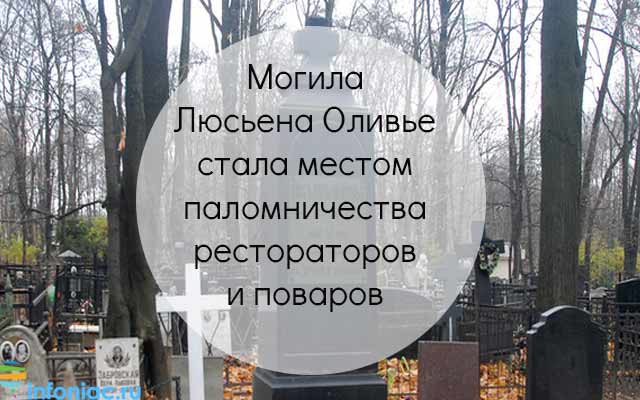
Olivier died on November 14, 1883. How do we know the exact date of death of the Hermitage manager? The fact is that in Moscow, at the Vvedenskoye Cemetery, there is Lucien's grave, which indicates the date of his death. However, the most surprising thing is that this grave was discovered only in 2008. The burial site was then restored.
Why did Olivier's grave remain unknown for more than a hundred years?
The fact is that Lucien Olivier's grave is located in the old part of the cemetery, where very old burials are located. Some of them are more than two hundred years old (the cemetery was founded in 1771, and those who died from the plague were originally buried there).
It is not known whether Lucien Olivier's burial place was visited by his contemporaries. There are also no reminders of his relatives. However, after its discovery, the grave began to arouse, pardon the pun intended, the keen interest of our contemporaries. She is often visited by people (especially on the anniversary of Olivier's death) who want to reach great heights in the restaurant business.
Aspiring chefs also come there, as well as those who dream of creating an outstanding dish that would make them famous for centuries. Some talk to each other, others just stand silently… Who knows: maybe they are listening to Lucien's spirit, who would tell them the recipe for the original Olivier salad, which, according to many historians, he took to his grave?