
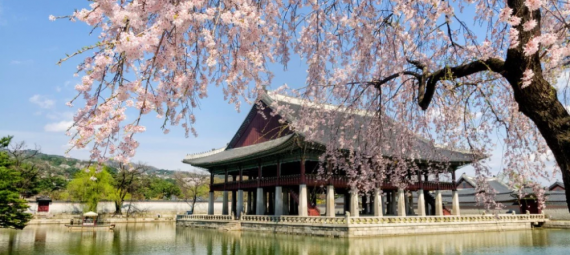
South Korea is not the largest country in East Asia by area, but there is something to see in each of its nine provinces. Here, traditional Buddhist temples and luxurious royal palaces with a rich history are side by side with futuristic skyscrapers, and ancient national culture is combined with fashion trends and modern technologies.
Cherry blossoms are not the only thing worth coming here for. I will tell you what to see in South Korea and what the main attractions of the country should definitely be added to your itinerary.
Gyeongbokgung Palace Complex
Gyeongbokgung, or “Heaven—blessed Palace” is the oldest royal residence and the main attraction of Seoul. The complex was built in the XIV century during the reign of the Joseon dynasty, later it was rebuilt several times and restored after fires. The palace ensemble includes the throne room, where Wang (as kings are called in Korea) received foreign ambassadors, as well as a watchtower and several pavilions.
There is a National park on the territory of the complex
The Palace Museum of Korea, where jewelry, clothing items and even a royal car are displayed. You can get acquainted with the history and ethnography of the country at the National Folklore Museum, and after the tour you can relax in a beautiful park by the pond. The visit should be timed for a spectacular changing of the guard — it is held twice a day, at 10:00 and at 14:00.
The ticket price for adults is 3,000 won (205 rubles; 1 won = 0.06 rubles, November 2023), children — 1,500 won, for children under 7 years old — free of charge. Additional information in English can be found on the official website.
Changdeokgung Palace
The former summer residence of the Joseon Dynasty in Seoul is famous not only for its architecture, but also for its beautiful surroundings. The pearl of the complex is the secret Huwon Garden, where the royals strolled, rested in gazebos and practiced archery. However, you can only visit it with an excursion.
There are several beautiful ponds on the territory of the garden, as well as the “Jade Stream” Onnyuchon, above which there are several pavilions, where Wang himself usually took the exam from officials.
Entrance fees: adults — 3000 won, children — 1500 won, for young visitors up to 7 years old — free of charge, with a tour of the secret garden — 5000 and 2500 won, respectively.
Jeonme Temple
The oldest Confucian temple in South Korea. Its history began in 1394, when the Joseon dynasty had just ascended to the throne. The shrine was repeatedly restored after fires and destruction. Koreans are in awe of the monument: it is believed that the spirits of the dead rest here, who protect the living descendants. The memorial tablets of the Korean rulers are also kept in the temple.
There are two main halls in the complex: Jeongjong, where the funeral rite was held, and Yeongyongjong, which is called the room of eternal peace and tranquility. It is best to visit the temple with a guide, and after the tour you can walk through the beautiful park.
Free admission without guided tours — on Saturdays and on the last Wednesday of each month. At all other times, the entrance with a guided tour in English costs 1000 won.
Namisom Island
Another landmark place on the Korean peninsula appeared after the construction of the Cheongpyeong Dam. A recreation park has been created on an area of 4 km, where the beauty of nature is combined with art. Namisom is a state within a state: The island has its own flag, anthem and even currency.
There are many beautiful places here: picturesque alleys with different tree species, ponds, as well as entire galleries of sculptures and art objects. Ostriches and chipmunks can also be found in the park. It will be especially interesting for young visitors: there are several play areas on the island for them.
Thrill seekers will not be bored either: the zipline leading to the island is one of the longest in Asia. Its length is more than 940 m, the flight lasts about four minutes. It is easy to get here from Seoul by bus or train.
Entrance fees: adults — 16,000 won, children — 10,000 won (ferry included in the price), a shuttle trip to the island will cost 25,000 won round trip, zipline – 49,900 won (return ferry ticket included).
Soraksan National Park
Getting to know South Korea, you definitely need to visit at least one of the country’s nature reserves. Soraksan National Park is the visiting card of the peninsula. There are picturesque views of mountain peaks, gorges, waterfalls and cliffs.
Several hiking trails of varying degrees of difficulty are available to tourists. Among the most popular is the route to the ruins of the ancient fortress of Kwongymson on Mount Tolsan: the local sunsets will not leave anyone indifferent. They get to the fortress on foot or by cable car. You can admire panoramic views of the Taebaeksan ridge, the East China Sea and take beautiful pictures for memory from the granite rock of Ulsanpawi. On the territory of the park there is one of the oldest Zen Buddhist sanctuaries – the temple of Sinhynsa, and next to it is a 15-meter bronze statue of a seated Buddha.
Hwaseong Fortress
The “blooming fortress” in the city of Suwon, 30 km from Seoul, was built in the XVIII century by order of King Jeonjo of the Joseon dynasty in memory of his father. The length of the walls of Hwasong is 5.7 km, the height is from 4 to 6 m, they offer views of the city blocks. For the convenience of travelers, a tourist train runs around the fortress, and you can appreciate the beauty and power of the structure from a bird’s-eye view by climbing over it in a balloon. On the territory of the fortress there is a temporary palace of Hwasong Heng, where the king and his entourage took refuge during the war. Today it is actively used for cultural events. Excursions are also available.
Entrance fees: adults — 1000 won, teenagers under 18 – 700 won, children — 500 won.
Hahwe Village
If you want to really immerse yourself in Korean culture, walk along the river and explore the scenic mountain trails, be sure to include Hahwe Village in your itinerary.
This is one of the most interesting and ancient places in South Korea. Free performances with traditional masks are held here several times a week, and in autumn participants of the traditional dance festival come to the village.
Here you can also get acquainted with national customs, attend a master class on weaving mats and get to a calligraphy lesson. And, of course, Hahwe is the perfect place to spend a couple of nights in a traditional hanok house with mats and yo floor mattresses.
Entrance fees: adults — 5000 won, students — 2500 won, children — 1500 won.
Jeju Island
The largest island and the smallest province in the country, which will appeal to beach lovers. Here tourists can admire tangerine groves, volcanic landscapes, and after the beach — visit museums, ethnoparks, waterfalls and bizarre cliffs. Popular attractions include the extinct Hallasan Volcano and the Love Land Sculpture Park.