
 Events
Content:
What will we see in the sky
What is a parade of planets?
How does a mini parade differ from a full parade of planets?
Do planets really line up along the same line?
How planetary parades affect Earth and people
On the morning of March 18, a mini-parade of planets can be observed in the sky. Mars, Jupiter and Saturn will take part in it. The mini-parade of planets can be seen at dawn or at dusk in the evening. The planets will be close enough to each other.
What we'll see in the sky
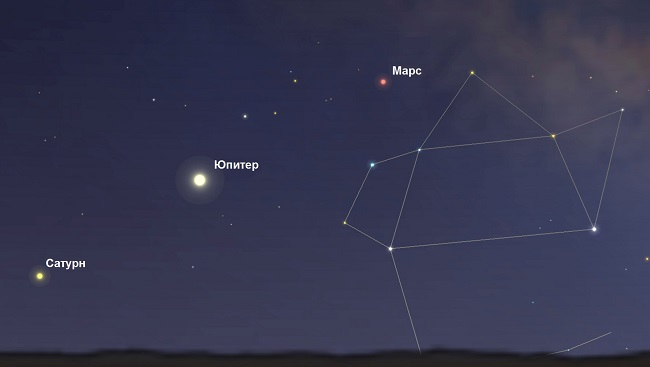
It is best to watch the parade in the morning, March 18. The Waning Moon in the last quarter phase will move near Jupiter, Saturn, and Mars. About 2 hours before sunrise at 6:38 Moscow time, the Moon will be under Mars — the planet will be right above the upper edge of the crescent moon. At the same time, Jupiter will be located to the left and above the Moon. The moon will slowly pass Mars towards Jupiter. However, the Moon's passage past Jupiter will prevent you from seeing the rising Sun. All three planets will be located to the left of the asterism “Teapot” in the constellation Sagittarius.
The location of the planets during the March 18, 2020 parade is modeled on the picture below:
© Space
To see the mini-parade of planets, you need to look South and Southeast in the morning, March 18, before sunrise, while in an open flat area. The planets and the Moon will be seen low above the horizon.
As you can see in the picture, Jupiter and Mars are quite close to each other. And in just two days, on March 20, Mars and Jupiter will connect (the planets will join in the night sky) — which happens only once every 20 years. You will find a link to the material at the end of the article, in the “Sources of Information” section.
What is a parade of planets?
A parade of planets is an astronomical event in which planets line up on one side of the Sun in a small area of the sky.
There are several types of planetary parades:
Full — all 8 planets line up;
The big one is made up of 6 planets;
Small — from 4 planets;
The mini parade consists of 3 planets.
Read also: 2020 astrological forecast: planetary hints, tips and important events
How does a mini parade differ from a full parade of planets?
While a mini-parade with three planets takes place 1-2 times a year, a full parade, when all the planets in the solar system line up in one sector of the sky on one side of the Sun, takes place about once every 170 years.
© mkarco/ Canva
Planetary parades are rare. And a full planetary parade is so rare that not everyone gets a chance to see it. The last time all eight planets lined up in a parade was 38 years ago, in 1982. The next time a full parade of planets, according to astronomers, will take place as early as 2161. And this is not surprising, because the farther the planet is from the Sun, the longer its year lasts. For example, if the Earth year is 365 days, Uranus orbits the Sun in 84 years, and Neptune orbits the Sun in almost 165 years. Accordingly, it is extremely rare for only these two planets to line up with the Sun, and even less often the rest of the planets line up with them.
Do planets really line up along the same line?
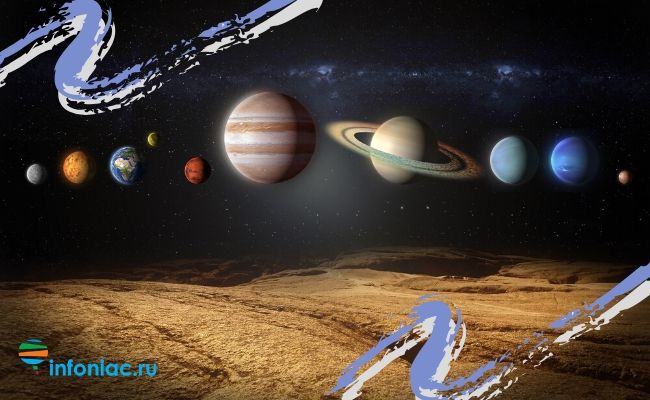
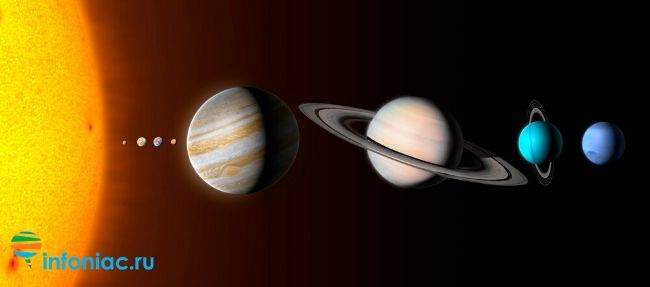
In fact, by definition, a parade of planets is the presence of planets in one sector of the sky from the point of view of an observer from Earth. But in reality, a parade of planets, in which they line up perfectly along one straight line, is not possible at all. If planets were orbiting in the same plane, as is often depicted in pictures, an ideal parade of planets could still be imagined. However, the planets' orbits are not actually on the same plane. In other words, each planet rotates in its own plane, which is different from the Earth's orbital plane and the orbital planes of other planets. Thus, each planet's orbit is slightly inclined to Earth's orbit. Therefore, astronomers believe that planets will never be able to form a perfectly straight series — this is impossible even theoretically.
But what is then called a parade of planets? When astronomers use this term, they don't mean planets line up in a straight line. In fact, the implication is that planets are just together in one small section of the sky on one side of the Sun.
An interesting fact! A parade of planets is said to be when several planets are in one small area of the sky for an observer on Earth. But if we could look at these same planets from the Sun's surface at the same time, they don't have to be in the same sector of the sky. Thus, a parade of planets is an event for an observer from Earth, while in fact, planets may not line up at all, or even approach each other.
According to astronomers, the parade of planets depicted by the artist in this picture is basically impossible:
© Image Team/Canva
Also read: 7 possible scenarios of the end of the world
How planetary parades affect Earth and people
If you've been interested in planetary parades, you've probably heard that they have a huge impact on our planet and on each person individually. Proponents of this theory argue that as planets line up in one line, their gravitational fields add up, and this has a huge impact on Earth, leading to natural cataclysms and changes in people's minds.
In reality, the gravitational effect of other planets on Earth is so negligible that it cannot have a significant impact on us, even if we consider the combined effect of all planets on our planet. In fact, only two space objects have a significant gravitational effect on the Earth: the Sun and the Moon. And the only “parade” that really affects our planet is the alignment of the Moon and the Sun. The Earth, Moon and Sun parade takes place during the full moon and the new moon (that is, twice a month), which causes the biggest sea tides.
To better understand how space objects actually affect humans, we suggest that you read scientific data. The table shows the gravity (in Newtons) that a person weighing 100 kg at the Equator experiences from the effects of each space object in the Solar System:
Astronomical body
Gravitational force (N)
Earth
980
The sun as close as possible to Earth
0.61
The sun at its maximum distance from Earth
0.57
The moon at maximum approach
0.0039
The moon at maximum distance
0.0029
Jupiter at maximum approximation
0.000037
Venus as close as possible
0.000022
Saturn at maximum approximation
0.0000026
Mars at maximum zoom
0.0000014
Mercury at maximum approximation
0.00000037
Uranus at maximum approximation
0.000000088
Neptune at maximum approach
0.000000037
All planets as close as possible to Earth
0.000064
To understand what effect a full parade of planets can have, let's add up the gravitational effect of all planets when they are as close as possible to Earth. As can be seen from the table, even if all planets lined up along the same straight line and were at the same time closest to Earth, their total impact on a person weighing 100 kg was would be 0.000064 Newton, which is 53 times less than the moon's average gravitational effect.
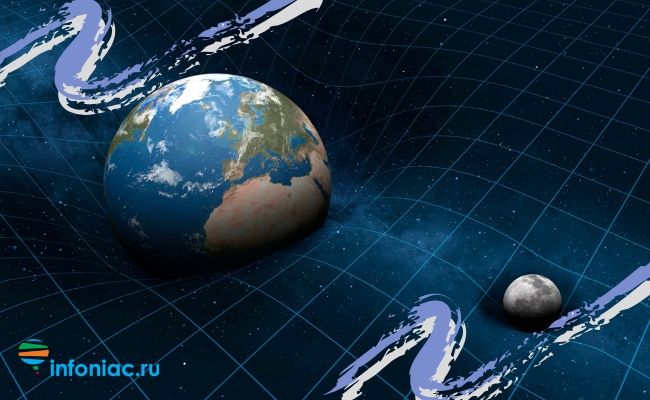
In addition, given that the Moon orbits in an elliptical orbit, its effect fluctuates at 0.0010 Newton every half month, which is 15 times more powerful than that of even a perfect parade of planets. In other words, the Moon's gravitational fluctuations as it rotates around the Earth affect people and the planet as a whole incomparably more than any parade of planets, whether full or small. Therefore, if we assume that a parade of planets causes unprecedented catastrophes on Earth and drives people crazy, then monthly fluctuations in the gravitational effect of the moon should cause 15 times more serious disasters. But, as we know, the monthly movement of the Moon at the closest distance to Earth does not cause earthquakes, catastrophes, or spikes in crime and war.
© Image Team/Canva
Read also: The most frightening planets you don't want to visit
An interesting fact! The assumption that a parade of planets threatens the Earth with terrible consequences was put forward by American astrophysicists Playgeman and Gribbin in their book “The Jupiter Effect”, published in 1974. In fact, they also popularized the term “parade of planets” itself.
As already mentioned, the perfect parade of planets will never happen. But sometimes planets take the position closest to an ideal parade — that is, they line up almost in line and appear in the sky next to each other. The previous similar planetary formation took place more than 1,000 years ago, in 949, and the next one will take place on May 6, 2492. Therefore, if a time machine is not invented soon, hardly any of us will be lucky enough to survive it.