
 Science
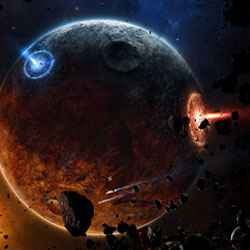
Giant asteroids like the ones that once killed dinosaurs could fall to the surface of our planet billions of years ago, but much more often than previously thought, said the agency's researchers NASA.
The killer asteroids that led to the extinction of dinosaurs hit Earth 65 million years ago, and these giants could reach 10 kilometers in diameter!
Exploring ancient mountains in Australia and using computer models, scientists estimated that about 70 asteroids of this size or larger fell on the surface of our planet between 1.8 and 3.8 billion years back. During this period, approximately 4 asteroids of the same size fell to the surface of the moon, the researchers said.
Scientists were able to prove that these events took place by examining traces of collisions in rock layers that contained roughly spherical fragments — drops the size of a grain of sand called spherules.
These molten droplets were thrown into space during a mega-collision with Earth. They then returned to Earth when they were already solid, forming common sedimentary rocks known as spherule layers.
“These layers suggest that the Earth has been heavily 'bombarded' by asteroids,” says William Bottke, leader of a team of scientists at the Southwestern Research Institute in Colorado. “The origin of these formations has long been a mystery.”
New research supports the theory that Jupiter, Saturn, Uranus, and Neptune were formed in other orbits about 4.5 billion years ago and then “migrated” to their orbits about 4 billion years ago due to the interaction of gravitational forces in the solar system.
This event caused a barrage of comets and asteroids that began to collide with planets. This period was called the Late Heavy Bombardment.