
 Ecology
In a remote Indian village, residents realized that when drinking water is scarce due to global warming, water can be stored in large blocks of ice, creating so-called “artificial glaciers “that will help you “survive” in dry spring conditions.
Located in the western Tibetan Plateau, the village of Skara, in India's Ladakh district, does not particularly attract tourists. “It's a beautiful place, but it's pretty hard to get here,” says Amy Higgins, a graduate of Yale School of Forestry and Environmental Research.
“A lot of people I met in Delhi and told me I was going to Ladakh looked at me like I was going to the moon,” says Higgis.
People who live in Skara village, as well as in other nearby towns, feed by growing crops such as oats for their own consumption and also sell them in neighboring areas. In the past, locals collected water for crops in the form of ice on glaciers in the Himalayan highlands.
However, in recent decades, due to global warming, the cycles of melting glaciers in the Tibetan Plateau have changed. These areas are heated by an average of 2 degrees Celsius more than in the rest of the world. April and May, when the traditional agricultural season begins, are quite dry months in these places, so locals are short of water when they need it most. At this time, it is important to moisten the soil well, otherwise there will be no harvest in summer.
“Self-made” glaciers
In the late 1980s, during the winter, an engineer from Skara named Chewang Norphel found a solution for his fellow villagers while walking around his backyard. He noticed that part of the stream in his garden was frozen and some was not. This was due to the fact that the water ran too fast to be covered with ice, but in one place the stream was rather weak and froze.
Over the next few years, Norfel worked to develop an irrigation system that used the same natural principle. As a result, artificial glaciers were created. There are already ten of them today.
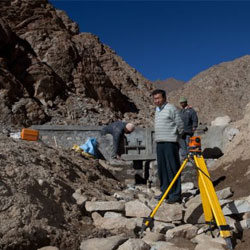
To create such glaciers, Norfel and his team of engineers directed the river's streams into a nearby valley, carefully blocking them with rocks. Glaciers form during the colder months from October to December. When water reaches the valley, it freezes in small shallow pools. The process is repeated until the ice is about a meter thick. If you run too much water at once, it will not be able to freeze. Patience is required.
The largest artificial glacier covers an area of about 1.5 square kilometers. Because artificial glaciers are located lower than actual glaciers, they melt earlier, just as residents start farming.
“You could do the same thing by building larger water tanks,” says Higgis. “But it would take more materials, and the water would evaporate because these places have a lot of sun . You would also be concerned that the water doesn't go bad.”
The danger is in the future
Some experts believe that this is a good solution to the problems that global climate change poses to many people. However, this solution is good for the short term for small settlements located high in the mountains. They are concerned that in the future, the gradual disappearance of natural glaciers in highland areas will prevent the creation and maintenance of artificial glaciers at all.
Storing water in the form of ice and then releasing it by natural processes is a cheap alternative to building dams, scientists say. Norfel estimates that the actual glacier contains about 28 million liters of water that can be used to create artificial glaciers to irrigate 155 hectares of land.
The amount of water stored in artificial glaciers is a drop in the ocean compared to the amount of water that flows from glaciers into the Indus River. Therefore, artificial glaciers will not have a negative impact. If water were not taken to irrigate the crop, it would simply be sent to the Arabian Sea in October-November.
Scientists are worried about how engineers will be able to maintain such meticulously built structures with ice reservoirs when real glaciers will melt dramatically. Due to global warming, glaciers may melt completely, leading to floods and threatening the existence of artificial glaciers.
Today, climate change is just beginning to be felt, but in the future, warming will lead to the death of glaciers, including artificial ones, scientists said.
Higgins added: “If global warming continues and glaciers melt due to high temperatures, we won't have water to support artificial glaciers. We won't have water to live in, but this would be a bad scenario not only for the Ladakh region, but also for other areas in the world that depend on glacier water resources.”
Currently, artificial glaciers in Skara and other nearby settlements are providing significant assistance to farmers in fighting drought. With these tools, they can not only sow crops on time, but also plant crops that need more water, such as potatoes or peas. People have become more dependent on these artificial glaciers.