
 Ecology
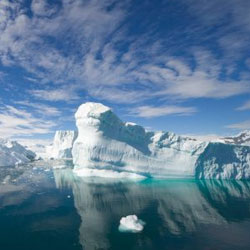
Huge layers of Antarctic ice were formed when the level of carbon dioxide in the Earth's atmosphere fell sharply millions of years ago, scientists say.
Carbon dioxide enhances the greenhouse effect, it keeps thermal radiation from leaving the Earth, so the planet's climate is becoming warmer. High concentrations of carbon dioxide in the atmosphere contribute to global warming, while low levels of carbon dioxide, on the contrary, cause cooling. The Earth has seen many periods of warming and cooling, which have affected the planet's climate.
About 34 million years ago, glaciers began to form that covered Antarctica, but what exactly caused this ice is still a matter of debate for scientists. Some of them believe that carbon dioxide levels rose before and during this period known as “climate change in the Eocene and Oligocene periods,” which contradicts another version that for ice formation is necessary for the level of carbon dioxide in the atmosphere to decrease.
Today, scientists believe that a sharp drop in carbon dioxide levels in the atmosphere played the most important role in the formation of Antarctic glaciers.
Ancient algae
In order to find a link between carbon dioxide levels and cooling during this period, scientists studied alkenones, dense organic components that are produced only by certain types of algae. These photosynthetic organisms probably used carbon dioxide that came into the water from the air, so if you look at the chemical composition of ancient alkenon reserves, scientists could answer exactly what level of carbon dioxide was observed in the atmosphere at that time.
Paleoclimatologist and geochemist Mark Pagani from Yale University and colleagues collected alkenons at 6 deepwater sites around the world. They took samples near and far from the poles to get an idea of what the level of carbon dioxide in the atmosphere was.
The researchers drew attention to the carbon isotopes of these components. All isotopes of this element have the same number of protons, but different numbers of neurons, for example, carbon-12 has six neurons and carbon-13 has seven neurons.
The more carbon dioxide was in the water and, accordingly, in the air, the more often alkenones consisted of light carbon isotopes. This is because enzymes that help algae absorb carbon dioxide prefer these isotopes, and the more gas there was, the more enzymes were able to absorb carbon, that they liked.
Climate and carbon dioxide
After studying the level of carbon isotopes in alkenons, scientists found that carbon dioxide apparently decreased in the atmosphere before and during the formation of glaciers in Antarctica. Studies that were published earlier were based on areas with high levels of carbon dioxide, but these data failed to provide a complete picture of the global level carbon dioxide on the planet, said Pagani.
“The study proves that there is a clear link between carbon dioxide levels and climate change,” the scientist says. “This was not a surprise to anyone studying the history of climate change on Earth. Geological studies reveal the nature of the climate's sensitivity to the level of carbon dioxide and other greenhouse gases. In the future, we plan to study the level of carbon dioxide during the hottest periods on Earth.”