
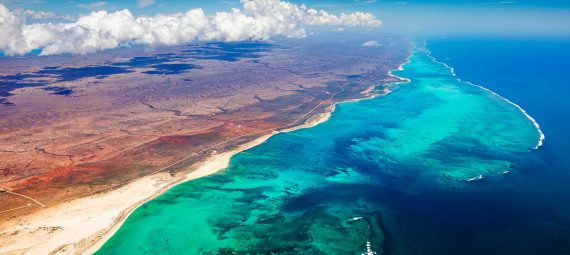
Willandra Lake District
The Willandra Lake District is located in the southwestern part of New South Wales in Australia. About two million years ago there were 19 lakes here, which eventually dried up, but their bottom became an excellent soil for salt marsh vegetation. In some places, you can also see islands of eucalyptus groves. On this territory, the most ancient burial sites of people have been recorded, which are dated to 45-60 thousand years BC. The lake district of Willandra is listed as a UNESCO World Heritage Site. The landscape of this area resembles lunar landscapes and has remained virtually unchanged for many millions of years. A tenth of this territory is occupied by Mungo National Park.
Rain forests of the East coast of Australia
An equally important natural attraction is the rain forests of the east coast of Australia. They represent a vast territory, including about 50 nature reserves, these are the most extensive subtropical forests in the world, the total area of which reaches about 370 thousand hectares. The main value of rain forests lies in the unique accumulation of ancient vegetation, as well as numerous geological formations with a multi-million-year history.
During a walk through the forests, you can see plants that were on earth back in the time of the dinosaurs, as well as see volcanoes and gorges formed in the prehistoric era, admire beautiful rivers and waterfalls. Forests are inhabited by rare species of mammals and birds, which also makes them a valuable object of world importance. In the unique rain forests, you can see plants that are not found anywhere else in the world, they are endangered.
Blue Mountains Mountain Area
The Blue Mountains mountain area (included in the UNESCO World Heritage List) is a grandiose sandstone plateau with all kinds of canyons, gorges and rocks covered with eucalyptus forests. The territory, which stretches just outside the city limits of Sydney, is part of the state of New South Wales and is part of the Great Dividing Range. This picturesque area, whose total area exceeds one million hectares, is divided into eight different protected areas.
Oily vapors refracted in the rays of the sun at a certain angle, eucalyptus forests give the air a bluish hue, which is why the Blue Mountains got their name. At sunset, the mountains begin to radiate a golden glow, presenting an indescribable sight in beauty.
Ningaloo Coast
Ningaloo is the largest reef of the Green Continent and the only large reef in the world located close to land. The total length of the coast is about 260 kilometers. Ningaloo is located in the Indian Ocean, in the Western part of Australia, 1200 km north of Perth.
Closer to summer, the reef turns into a Mecca for divers from all over the world who come to keep whale sharks company. These sharks are harmless to humans: its mouth is huge and full of small teeth, but these jaws are not able to crack the prey, much less crush it. In addition, the whale shark has a very narrow throat, which will not miss either medium-sized fish or a person. These giants feed mainly on plankton, filtering out seawater.
The diversity of underwater flora and fauna – 250 species of corals and more than 450 different species of fish. Here you can see many different types of hard corals of a wide variety of shapes and colors, anemones with clown fish inhabitants and much more.
From mid-summer to late autumn, humpback whales can be seen off the coast of Ningaloo, and in January and February, you can watch how sea turtles get out on land and lay eggs. A few years ago, a new species of sea sponges was discovered in these places, which were previously unknown to science.