
Asama
Mount Asama and the active volcano of the same name are located on the largest island of Japan – Honshu. The last time lava from the mouth of this volcano erupted in 1783 and thus claimed the lives of thousands of people. In 2009, the mountain just decided to “breathe” and showered all the nearby villages with ashes, and the echoes of this phenomenon were noticeable even in Tokyo. Currently, the mountainside is used as a ski resort, as well as local and tourists like to bask and relax at the nearby hot springs.
Sakurajima
This is the name of a stratovolcano, which consists of three peaks. The largest of them is Minami-Dake and regularly spews ash clouds on the nearby town of Kagoshima. The most interesting fact is that you can climb to the top of the crater on foot in just a couple of hours and watch all the surroundings from high. At the same time, you will also be able to see how big the crater is and how much lava can come out of it – these scales are simply amazing.
Mount Unzen
There have long been mountains on the island of Kyushu, the peaks of which long ago spewed lava and poured it all around. However, over the centuries, the volcanoes calmed down and took on the appearance of simple mountain peaks dusted with snow. There was beautiful nature around them and the Japanese decided to organize a national park here. However, in 1990, the top of one of the mountains literally exploded, and began to pour lava all around. Since then, of course, the volcano has cooled down, but the consequences of its eruption are still visible.
Aso-San Mountains
On the same southern island of Kyushu, another mountain range lurks, which often likes to spew lava on nearby villages. This is a volcano with three peaks, which is called Aso or Aso-San. Besides the fact that he is very dangerous, he is also incredibly beautiful. In the crater itself, after the eruption, a turquoise acid lake is formed, which can be viewed from a helicopter. The walk will be simply amazing, and you will be able to learn more historical data about this beautiful volcano.
Fujiyama
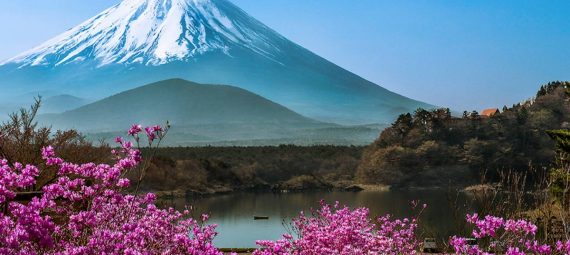
Or just Mount Fuji and its volcano of the same name became a symbol of the whole of Japan many years ago. This is the same conical mountain of an ideal shape that is painted on postcards from the Land of the Rising Sun, on Japanese money and on other things that are somehow connected with this state. The top of Mount Fuji is covered with a layer of snow in winter, but in summer it thaws and every tourist can climb to its top. You should be prepared for the fact that you will find yourself at an altitude of 3800 meters above sea level and mountain sickness will not pass you by. However, to stay above the clouds and enjoy the views that open from Fujiyama is simply necessary – it’s like a fairy tale.
It is believed that at the moment this volcano is not active. The last eruption of lava was in 1707-1708, since then the mountain no longer “breathed”. However, not so long ago, Fuji still managed to fill up with volcanic ash all the towns that are at its foot.
Exploring the volcanoes of Japan is an interesting activity for the most inquisitive tourists. It is very beautiful and interesting, fascinating and at the same time dangerous. If all these factors are the components of an ideal trip for you, then go to the land of the rising Sun right now!