
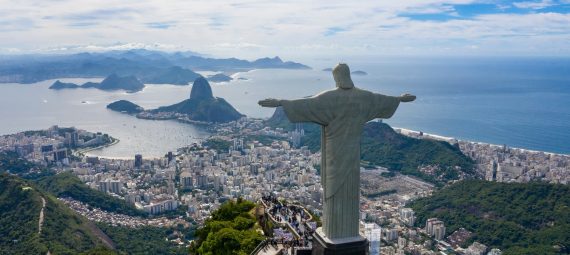
1. Christ the Redeemer Statue
Christ the Redeemer in Rio de Janeiro is the most famous statue of Jesus in the world and the symbol of Rio, as well as the main attraction of Brazil.
The idea of placing a large Christian monument on the top of Mount Corcovado in Rio dates back to 1850, when a local Catholic priest asked Princess Isabella for money to build a monument, but she refused. Construction began only in 1926 and ended in 1931.
Christ the Redeemer is considered the largest art Deco statue in the world. It is the 5th largest statue of Jesus in the world with a height of 30 meters, not including an 8-meter pedestal. The arms of the statue are spread out 28 meters wide. Christ the Redeemer is located at the top of the 700-meter-high Corcovado Mountain.
2. Iguaçu Falls
Located in the horseshoe-shaped gorge of the Iguazu River, the Iguazu Waterfalls are both picturesque, ferocious and modest. Iguazu waterfalls are simply amazing, there are about 275 waterfalls on a 3-kilometer stretch. This is a real miracle of nature. The impressive natural power and noise from the cascades of waterfalls will remain in your memory for a long time, and this is not to mention the jungle that surrounds the waterfalls. In the area of the Iguazu Falls, the borders of 3 states converge, Brazil, Argentina and Paraguay. This UNESCO World Heritage Site is divided between Brazil and Argentina.
Iguazu Falls — the main natural attraction of Brazil is located in the Iguazu National Park. Viewing platforms on different levels provide places for perfect photos. Admire how the rushing water creates clouds of fog, and the sun’s rays form a rainbow. Feel the full force of the waterfall on board the boat while the experienced helmsmen immerse you in the boiling water. You will end the trip wet, so be sure to protect your camera and valuables.
If you have enough time, it’s worth looking at the waterfalls from the Argentine side of the Iguazu River. Hiking trails lead through forests to viewing platforms offering close-up views, including a magnificent view from above of the Devil’s Throat. Iguazu Falls is a 20-minute drive from Foz do Iguazu city center. Public buses often run between the waterfalls and the city.
3. Amazon River
The Amazon has the largest water basin in the world, which occupies almost half of the territory of South America. The Amazon is the second longest river in the world, formed by the confluence of the Maranhon and Ucayali rivers. The Amazon River basin is home to a variety of Native American cultures, as well as a habitat for a huge number of wild animals and impenetrable jungles.
4. Rio Carnival
Brazil and carnival are synonymous words, it’s hard to imagine Brazil without carnival. Carnivals in Brazil are held in every corner, but the biggest and most famous carnival is undoubtedly the Carnival in Rio de Janeiro. Rio Carnival attracts two million people a day to the streets of the city and almost half of them are tourists. Carnival in Rio lasts 4 days. Carnival in Rio these days is everywhere, on the streets and squares, in bars and clubs and in all other corners of Rio.
5. Pantanal
A large tectonic depression in Brazil, which is almost completely swampy, is the Pantanal. Pantanal is located in the Paraguay River Basin and is one of the largest and most diversified freshwater wetland ecosystems in the world. The Pantanal is also one of Brazil’s main tourist attractions. It is believed that the Pantanal in Brazil is the best place to see wild animals.
6. Salvador
The colorful city of Salvador is the jewel of Brazil’s cultural identity. While Rio in the south has become a cosmopolitan center, El Salvador has retained a strong cultural identity. Founded in 1549, El Salvador was the capital during the heyday of the slave trade. The historical center of the city is included in the UNESCO World Heritage List.
But the real attraction of El Salvador is its amazing beaches
Praia do Porto da Barra is a beautiful beach in Salvador de Bahia, where you can swim all year round in the turquoise and beautiful waters of the ocean. This always crowded strip of coast overlooking the Bay of All Saints is an ideal place for those who want to relax on the beach. This city beach has been among the 50 best beaches in the world since 2014 and attracts many tourists from all over the world.
El Tunco – Without a doubt, El Tunco is one of the most popular beaches (at least among tourists) in El Salvador. Most likely, photos with the famous rock formations on the beach will appear when searching for photos of El Salvador.
La Libertad is a very popular beach among locals (unlike El Tunco, which is more popular with tourists). This is a place where you can go on weekends to escape from the city. The main attractions here are the pier, the fish market and dozens of seafood restaurants along the seaside promenade. There are many restaurants selling traditional dishes, ice cream, pastries and coffee. Don’t worry if seafood is not to your taste. There are shops and kiosks selling handmade products, clothes, shoes and souvenirs.
7. Historic Center of Olinda
After its foundation in 1535 by the Portuguese navigator Duarte Coelho, Olinda quickly became a thriving city thanks to the sugar trade. Sugar was in great demand on the international market at that time, and when the city was at the peak of its participation in the sugar market, several religious orders, including the Jesuit Order, settled in Olinda, thanks to which there are many monasteries and churches in the city, as well as a beautiful historical center of the city, which is included in the UNESCO World Heritage List.
8. Fernando de Noronha
Fernando de Noronha is an archipelago of 21 islands and islets in the Atlantic Ocean. Its clean beaches, landscapes and wildlife attract tourists from all over the world. The island is also home to one of the largest breeding colonies of seabirds in the South Atlantic, this unique ecological clean place is included in the UNESCO World Heritage List and most of the archipelago is located in the National Marine Park of Brazil.
The archipelago was discovered by Amerigo Vespucci (1454-1512), an Italian merchant and cartographer in 1503.
9. Teatro Amazonas
The Amazonas Theater, or Opera House, is located in the city of Manaus, in the heart of the lush Amazon rainforest. The construction of the theater began during the heyday of the rubber trade using materials from all over the world, with furniture from Paris, marble from Italy and steel from England. The dome of the theater was covered with 36,000 small ceramic tiles painted in the colors of the Brazilian flag.
The world-famous Italian tenor Enrico Caruso was the first to perform on the stage of the theater, the performance took place on January 7, 1897.
10. Ouro Preto
The city was founded at the end of the 17th century, Ouro Preto (Black Gold) was the center of the gold rush and the golden age of Brazil in the 18th century. With the depletion of the gold mines in the 19th century, the influence of the city declined, but the churches, bridges and fountains remain as evidence of the past prosperity and exceptional talent of the Baroque sculptor Aleijadinho, who created in Ouro Preto
Today, the city is a UNESCO World Heritage Site, attracting tourists from all over the world and who post more than 1.1 million photos on Instagram per year!