
 Incredible facts
Coral reefs have long been in danger of extinction, mainly due to the effects of global warming. If this process continues, this threat will become a reality in 20-50 years.
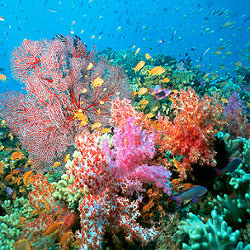
Coral reefs are the richest underwater ecosystem: they are also called ocean jungles. Although they only occupy 0.2 percent of the ocean floor, about a third of all marine creatures live in their thickets.
The reasons for the gradual extinction of corals are increased water temperature due to global warming, increased acidity, pollution and overfishing. An increase in water temperature leads to another dangerous process – coral bleaching, when they produce symbiotic algae that give them their color. The problem is that when corals bleach, they do not photosynthesize, and therefore cannot feed. If corals don't regain color within a few months of bleaching, they die. In 1998, 16 per cent of all coral reefs died as a result of this process. Almost all reefs off Indonesia's coast were bleached in 2010. It takes several years for coral reefs to recover.
Rachel Jones from the London Aquarium adds that corals live in special conditions — on the border between air and water, and when these conditions change negatively, corals do not can adapt to them.
Let's save coral reefs!
Environmental experts have developed a project that aims to save 10 species of coral that are threatened with extinction in the near future. Among these species, mention should be made of Fizogyrou pearl coral, a source of food for biss turtles, and mushroom coral, which is home to 15 species of shrimp.
Work will be carried out in certain regions: the Philippines, the Mozambique Canal and the Caribbean. According to coordinator Catherine Head, the project will initially last 2 years, and scientists from the London Zoological Society will train local specialists. As a solution to this problem, researchers propose to turn coral concentrations into protected areas, but in the meantime they are trying to increase the resilience of reefs to climate change.
An example for researchers is the coral reef off the Chagos archipelago, which bleached in 1998 and quickly returned to normal.