
 Events
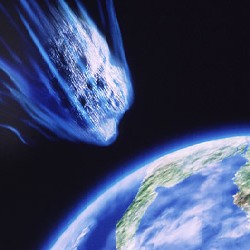
Some scientists believe that millions of years ago, an asteroid that collided with Earth caused the extinction of dinosaurs that reigned on the planet at that time. It has destroyed almost every living organism on Earth. But recently, theories have been put forward that asteroids not only take life, but also give it. Two teams of astronomers working with NASA's infrared telescope in Hawaii have discovered that the asteroid Themis-24, which orbits the Sun between Jupiter and Mars, is covered with a thin layer of ice. This is the first time astronomers have found ice and organic compounds on an asteroid.
This discovery supports the theory that comets and asteroids that collided with Earth billions of years ago brought water and carbon molecules to Earth. Both of these substances are essential to life, but it is still unclear how frozen water could remain on the surface of an asteroid that is hot enough to melt ice for billions of years.
Scientists say this is only possible if evaporated ice is replaced by water from the interior of the asteroid. In other words, it is quite possible that Themis-24 contains water reserves in its minerals.
Moreover, the distinction between rocky asteroids, which cannot have water due to their proximity to the Sun, and comets made up of the same minerals, in addition, is blurring to water and dust. A distinctive feature of comets is their tails, which are formed when the ice melts when the comet passes close to the Sun.
According to Andrew Rivkin, the lead author of one of the studies, scientists previously believed that only comets could bring water to the planet. But now, after this discovery, it can be assumed that asteroids were also sources of considerable amounts of water, especially if 20 or 30 percent of their mass was water.
Rivkin and his colleagues observed Themis 24 from 2002 to 2008, during which time they studied the wavelength of reflected sunlight to find out the composition asteroid surfaces. This is how they found ice mixed with carbon compounds.
Scientists from the second group, led by Umberto Campins, who worked independently of the first group of astronomers, also discovered water and organic compounds, but they We used a different research method.
Based on the fact that Themis-24 rotates around its axis every 8.37 hours, astronomers tried to obtain ray spectra on four sides of the asteroid, and created a rough map of its surface. They found that the ice was evenly distributed over the entire surface.
These studies provide clues to some of the mysteries behind the origins of our solar system 4.5 billion years ago.
These discoveries show that some objects in the asteroid belt have not changed since their formation. Now you don't have to speculate about the composition of water on ancient asteroids, but you can simply study the water on their surface.
Despite the presence of water and organic compounds on the asteroid, this is not enough to create life on them. This is hampered by the absence of atmosphere and water in the liquid state, as well as solar ultraviolet rays.