
 Ecology
In volcanic ice caves at the edge of the world, biologists have discovered the mystical biosphere of the Earth's crust. The caves were found at the top of the Antarctic plateau of the Ereb Mountains, a dormant volcano that rises 3,794 meters above sea level. Cave microbes that were isolated from those living on the surface developed in a completely different way.
Due to the fact that the caves did not have any organic matter for nutrition, microbes were forced to “feed” on rocks. They derived their livelihoods from metals and minerals like iron and manganese, like other microbes found below the Earth's surface.
“Caves and mining mines are a good thing because they allow scientists to reach deep layers of the Earth's crust,” says Hubert Staudigel of the Scripps Institute of Oceanography University of California San Diego.
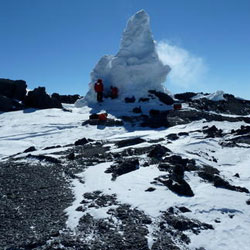
Staudigel and his colleagues took biota samples from Antarctic ice caves. Scientists also explored a small cave under the Harry's Dream Ice Tower and two other caves, Warren and Warren West.
Cracks form in the Ereb ice caves, from which hot gas escapes. This gas melts the lying snow, resulting in the formation of underground cavities — caves. Ice towers learn their intricate shapes when evaporation is pushed to the surface into fresh air, which is very cold. The pairs immediately freeze, turning into towers.
Due to the volcanic heat, three sites explored by scientists — the Warren, Warren West and Harry's Dream Caves — were warmer than the environment. They had temperatures of 18, 2 and 11 degrees Celsius, respectively.
Although scientists were not afraid to freeze to death in caves, these sites turned out to be quite difficult to research. In order to get to them, it was necessary to go up the steep and remote Ereb Mountains. It was also quite dangerous to go down to the caves.
“We had to rope down a hole about 15-20 meters long,” Staudigel said about the Warren Cave. “It has a lot of very complicated tunnels. This cave looks like a rabbit hole, which is why it was named that.” (“Warren” means “rabbit hole” in English).
The researchers identified and grew themselves the microbes they found in the ice cave to understand how this unique ecosystem works. They found a wide variety of interesting microbes.
“We found unknown communities of eukaryotes and prokaryotes, living organisms whose cells have and do not have a pronounced nucleus,” Staudigel said. Working in the Aebus Mountains is part of a large expedition seeking to learn more about the vast, mysterious underground biosphere that is still unexplored. Ice caves will help shed light on the lives of underground creatures.