
 tests Tests
Watch video, If you're too lazy to read
Watch video, If you're too lazy to read
Content:
Causes of Alzheimer's
Can Alzheimer's be cured?
Early symptoms and diagnosis
Puzzle tests
Text with letters and numbers
Extra number
Optical-spatial activity Mini-Cog
test
Rules
Scoring and evaluating results
Scientific justification for the effectiveness of the test
Test “Drawing hours”
Task
Assessment of the picture
Decryption result
Scientific basis for the effectiveness of the test
Brief mental status assessment scale (KSHPS, MMSE) Testing
instructions
Assessment of the result
The scientific basis for the effectiveness of the
test The Alzheimer's Questionnaire
Decoding the results
Development and scientific justification Questionnaire effectiveness
How to prevent Alzheimer's disease? 10 useful tips
Alzheimer's disease is a neurodegenerative disorder and the most commonly diagnosed form of dementia. The disease is named after the German scientist Alois Alzheimer, who was the first to describe significant differences between neurodegenerative and vascular dementia.
Alzheimer's disease is the cause of more than half of all diagnosed cases of dementia. At the same time, there is an increase in the number of cases worldwide, mainly due to the aging of the global population.
Causes of Alzheimer's Disease

© wildpixel/Canva
Work to determine the cause of Alzheimer's disease has been going on for many decades, but it is still not known for certain. There are only hypotheses, the most likely of which are the following:
disorders in the protein structures of neurons that make it difficult to transmit signals between nerve cells and, ultimately, lead to their death.
Infection of the brain with the bacterium Porphyromonas gingivalis, which lives in the oral cavity and provokes gum disease.
The accumulation of the beta-amyloid enzyme in the brain.
At the same time, factors that increase the likelihood of developing Alzheimer's disease are known for certain. The main ones are listed below:
age;
genetic predisposition;
accumulation of aluminum in the body (in the brain in particular);
arterial hypertension;
smoking;
overweight;
diabetes mellitus;
high cholesterol levels in the blood;
atherosclerosis.
Can Alzheimer's be cured?

© Ildar Imashev/Canva
Alzheimer's disease is a serious and incurable disease. As the disease progresses, a person develops cognitive impairment, memory problems worsen, develops speech, executive functions, perception disorders, etc. A person can no longer do with dementia without help.
However, although Alzheimer's disease cannot be cured, modern medicine has methods to stop or slow down the development of the disease as much as possible. A responsible approach to the diagnosis and treatment of the disease allows a person to maintain cognitive functions until old age. Therefore, it is extremely important to identify signs of dementia at the earliest stages, and to consult a doctor in time for help. To do this, you need to know the symptoms of early Alzheimer's disease.
Early symptoms and diagnosis of Alzheimer's

© Daisy-Daisy/Canva
When Alzheimer's disease develops, memory is the first to suffer. At the same time, a person forgets recent events or information received, while a person continues to remember events and knowledge gained in the distant past.
If you suspect Alzheimer's disease, you should consult a psychiatrist. The doctor will first suggest that the patient take one of the cognitive tests. If, based on the test results, the doctor concludes that there is no cognitive impairment, then the diagnosis will end, and the patient can be sure that he is not currently suffering from Alzheimer's disease threatens. If the test results are unsatisfactory, the doctor will refer the patient for more accurate examinations. In particular, the most accurate of these is brain tomography (magnetic resonance, computer, two-photon emission, etc.), which makes it possible to obtain layered images of the brain and study its structure in great detail.
Cognitive tests that detect Alzheimer's disease at an early stage are fairly simple and can be done at home. This is especially important given that many older people refuse to see a doctor because they do not want to admit that they need help and treatment. Below are some of the most common tests and methods used in clinics around the world.
Read also: 10 important brain signals that it is aging faster than your body
Puzzle tests
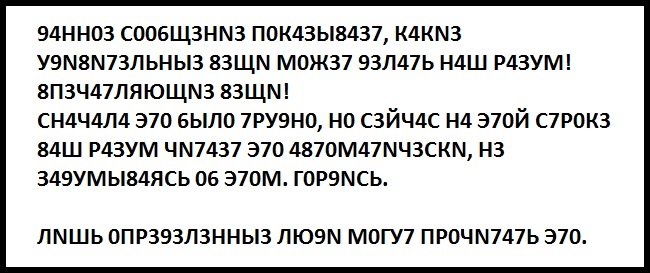
Text with letters and numbers
People with Alzheimer's have difficulty reading. The text in the picture below can be quickly read and understood the first time only by a person who does not have problems reading fluently. If a person sees only a meaningless set of letters and numbers, he may have a predisposition to Alzheimer's disease.
Extra number
And this is a mindfulness test. Invite the subject to find six among the nines.
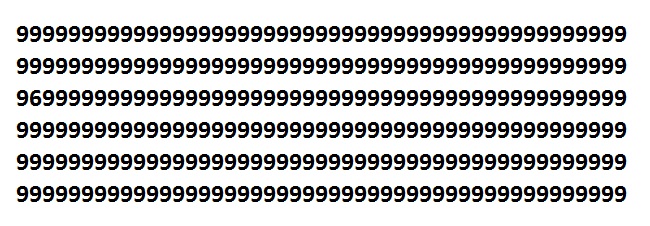
A healthy person will find a six in less than a minute. If the person took more than a minute to complete this test, they may be predisposed to Alzheimer's disease.
Optical-spatial activities
To complete this test, you will need to redraw the following drawing on paper.
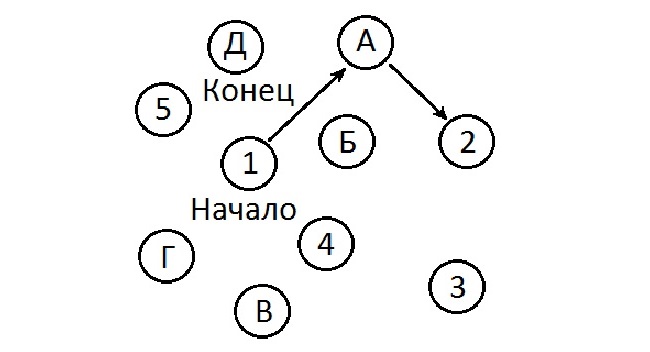
Ask the subject to draw arrows from number to letter in increasing order: that is, from number 1 to letter A, then to number 2, etc. If the person connects the circles in the following order: 1-A-2-B-3-B-4-G- 5-D, and the arrows will not cross — the test is passed. If a person makes a mistake and does not notice it himself, he may be predisposed to Alzheimer's disease. In this case, we recommend using more detailed tests (you will find them below).
Read also: TEST: What MENTAL diagnosis would Freud give you?
Mini-Cog test

© Robert Kneschke/Canva
The Mini-Kog test was developed by Soo Borson University in Washington, D.C., specializing in dementia. The advantage of the test is its brevity and the ability to be carried out by people who are not specialists in the medical field.
This short test is often used as part of the initial diagnosis of Alzheimer's senile dementia and other types of dementia in older adults. The Mini-Kog test allows you to assess the function of a person's short-term memory, visual and motor coordination, as well as the ability to complete tasks. It makes it possible to detect the development of Alzheimer's disease at the earliest stages.
Test rules
The test is fairly simple and doesn't take more than five minutes. It consists of three actions:
The subject is given 3 words: orange, window, pyramid. A person should repeat them and try to remember them.
After that, the subject must draw a watch on paper with arrows indicating the time — at twenty-eleven.
Then the subject must remember and name 3 words.
Scoring and evaluating results
For each correctly named word after drawing the watch, the subject receives 1 point.
3 points — there is no dementia.
1-2 points if the watch is correctly depicted — there is no dementia.
1-2 points if there are errors in drawing the clock, dementia is assumed.
0 points — dementia is assumed.
Scientific basis for the effectiveness of the test
Despite the fact that this test is used worldwide for the initial diagnosis of Alzheimer's disease, there are studies that confirm that the Mini-Kog test results cannot be trusted in to the fullest.
Specialists from the Department of Psychiatry at Queen's University in Kingston (Canada) conducted a meta-analysis, analyzing four studies of the sensitivity and specificity of the Mini-Kog test for detecting the disease Alzheimer's in primary care. In the course of these studies, 1517 cases were studied in which the results of the Mini-Kog test were compared with the results of diagnostics carried out in accordance with standard criteria for detecting the disease Alzheimer's. According to a meta-analysis published in 2018, the sensitivity of the Mini-Kog test varies from 76 to 100%. Scientists came to the conclusion that at the moment, including due to the small number of studies, there is insufficient evidence to recommend the Mini-Kog test for the initial diagnosis of dementia. You will find a link to the study at the end of the article
Clock drawing test

© Peshkova/Canva
The watch face test is very popular in the initial diagnosis of Alzheimer's disease. This test is used in many cognitive research methods (including the Mini-Cog test described above).
The Clock Drawing test was developed more than a century ago, back in 1915. However, at that time it was used to diagnose aphasia and apraxia. It was only since 1989 that this test began to be used to diagnose cognitive impairment (link to the material at the end of the article).
The task
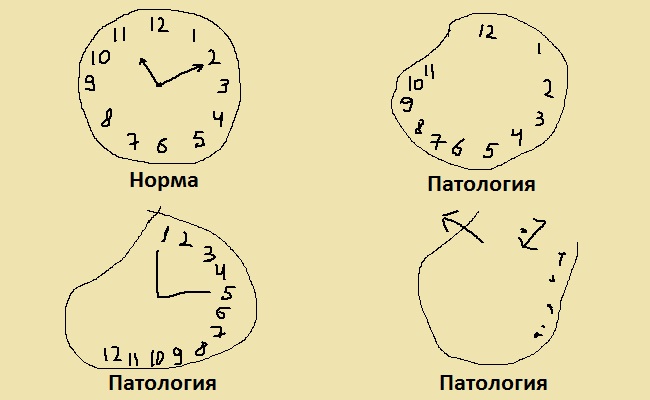
Give the person a piece of paper and a pencil, and ask them to draw a large round dial with numbers and arrows so that the clock indicates the time at 11:10. The score for the drawing is given in points from 0 to 4. Only a score of 4 points is considered a sign of complete health. The lower the score, the higher the severity of Alzheimer's disease or another type of dementia.
Assessing a picture
To rate a drawing, add 1 point for each part:
1 point for a closed circle;
1 point for showing the numbers in the right places on the dial
1 point for showing all 12 digits on the dial
1 point for correctly placed arrows.
Decoding the test result
Add up all the points you've scored. If 4 points are scored, there is no dementia. For any result below 4, Alzheimer's disease or another type of dementia is suspected. The more mistakes the subject makes when drawing a watch, the higher the severity of dementia.
Scientific basis for the effectiveness of the test
Scientists at Cleveland University Hospitals (Ohio, USA) conducted a study to determine the effectiveness of the “Drawing the Clock” test for detecting Alzheimer's disease at the earliest stages, as well as to identify the most useful elements of the picture that make it possible to diagnose this disease. The watch patterns of 41 patients over 39 years of age with MMSE test results (presented below) of 24 points or higher were analyzed.
Based on the results of the study, scientists came to the conclusion that the image of the clock hands is the most important diagnostic value. When making two or more mistakes when drawing clock hands, a person is highly likely to develop Alzheimer's disease. In turn, the correct image of the clock hands does not exclude the possibility of developing Alzheimer's disease, but this possibility is unlikely. You will find a link to the study at the end of the article
Read also: Test: Pick a pattern and we'll tell you how your brain works
Brief mental status assessment scale (KSHPS, MMSE)

© mail272/Canva
The Mini Mental State Examination (MMSE) is a short 30-point test that allows you to assess the state of cognitive functions and the extent of their impairment. It is widely used in various clinics for the initial diagnosis of Alzheimer's disease, as well as for screening as it is treated.
KSHOPS (MMSE) was developed in 1975 by psychiatric specialists Marshall Volstein, Susan Volstein, and Paul McHugh. Since then, this test has undergone minor changes and is still used in clinics around the world.
If someone in your family complains of problems with short-term memory, concentration, oral counting, speech, and other cognitive functions, suggest taking this test. It is quite simple and can be done at home.
Testing instructions
Orientation in time and space
The subject must correctly name today's date, month, year, as well as the day of the week and season. Also, a person must correctly state his location: the name of the country, town, region, house number or institution name, floor.
For each correct answer, 1 point is counted. For an incorrect answer — 0 points. Thus, the subject can get from 0 to 10 points.
perception
Ask the subject to remember three words you'll say to them. Then say three words slowly and clearly: orange, window, pyramid (another option: apple, carpet, key). After that, ask the person to say them.
For each word played, 1 point is counted. Thus, the subject can get 0 to 3 points.
Concentration and oral counting
Ask the subject to subtract 7 five times from 100 sequentially (the calculations must be done in the mind). Thus, he should name 5 answers: 93, 86, 79, 72, 65. For each correct answer, score 1 point.
If the subject does not want to make calculations, suggest another task: say the word “EARTH” the other way around. Score 1 point for every letter spoken correctly. In other words, if the answer is correct, the subject must say “YALMEZ” and he will be credited with 5 points. If the subject says “YAMLEZ”, only 3 points will be counted, etc.
Short-term memory
The test subject must remember and say the 3 words you asked him to remember during the perception test. Each correct word counts for 1 point. Thus, the subject can get 0 to 3 points.
Oral speech
Show the subject a wristwatch and ask them to name the item. Do the same with a stationery pen. For each correct answer, count 1 point.
Ask the subject to say the phrase “no ifs, and or but”. If the phrase is correct, count 1 point.
Thus, 0 to 3 points can be counted for this task.
3-step action
Give the subject a sheet of clean paper and say the following: “Take the sheet in your right hand, fold it in half and place it on the floor.” For each correct action, count 1 point. The maximum score is 3.
Reading
Give the subject a piece of paper with the “CLOSE EYES” command clearly and legibly written on it and ask them to do what is written on the sheet. If the subject closes his eyes, count 1 point.
A letter
Give the subject a blank sheet of paper, and ask them to come up with and write down a meaningful sentence on any topic that includes a noun and a verb. Spelling, grammatical and punctuation errors do not matter here. If a patient has written a proposal, count 1 point.
Copying a picture
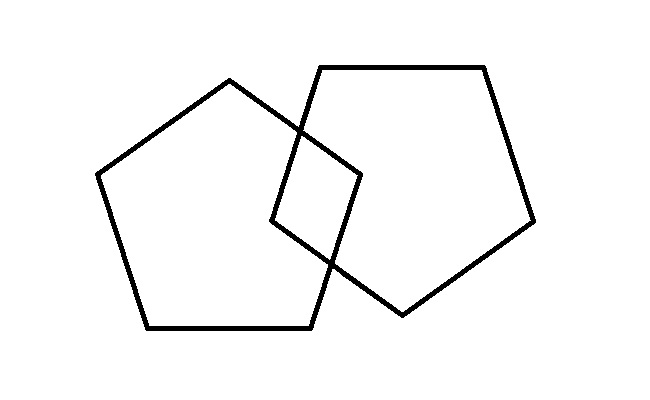
Give the subject a blank sheet of paper and a sample drawing showing two contemporal pentagons intersecting (as in the figure below). Ask them to copy the picture exactly. If the subject draws both pentagons, their lines are connected and they intersect like on the sample, and 1 point is counted. However, if one of the figures has more or fewer angles, the lines are open, or the figures do not intersect, the score does not count.
Assessment of the test result
The result is calculated by adding up the points scored for each test assignment. The maximum possible result is 30 points and corresponds to the normal state of cognitive functions. The lower the total score, the more severe the degree of dementia. The result, depending on the amount of points scored, is interpreted as follows:
28-30 points: cognitive abilities are normal.
24 to 27 points: there are cognitive impairments.
20-23 points: mild dementia.
11 to 19 points: moderate dementia.
0 to 10 points: severe dementia.
Scientific basis for the effectiveness of the test
Scientists at the University Foundation for Medical Sciences (Bogotá, Colombia) conducted a meta-analysis to study the effectiveness of the MMSE test for detecting Alzheimer's disease in people with lungs cognitive impairment. The meta-analysis combined and analyzed the results of 11 heterogeneous studies, which studied data from 1569 patients with mild cognitive impairment.
During the meta-analysis, scientists found no evidence to recommend the MMSE test as the only diagnostic method for identifying patients with mild cognitive impairment in who can develop Alzheimer's disease. Doctors are advised to use additional diagnostic methods in addition to the MMSE test. You will find a link to the study at the end of the article
Questionnaire for relatives (The Alzheimer's Questionnaire)

© Jivko/Canva
This survey will help you determine whether someone close to you has Alzheimer's disease or if there is no reason to worry. The test assesses all the abilities of a person suffering from dementia. The questionnaire consists of 21 questions. For each affirmative answer, 1 or 2 points are counted, for a negative answer – 0 points. The more points, the higher the likelihood of dementia.
Memories
Does your loved one have a bad memory? (Yes — 1, no — 0)
If there are problems, have they worsened in recent years? (Yes — 1, No — 0) Does
your loved one ask the same questions and repeat the same stories throughout the day? (Yes — 2, no — 0)
Does he forget about planned activities or visits? (Yes — 1, no — 0) Does he
lose things more than once a month? OR puts things in random places and then can't find them? (Yes — 1, no — 0
) Does he suspect that things are being hidden, shifted or stolen from him when it is difficult for him to find them? (Yes — 1, no — 0)
Orientation in time and space
Does your loved one often have difficulty remembering the time of day, today, month, year? OR does he use a calendar or other sources several times a day to remember today's date? (Yes — 2, no — 0) Does
he lose orientation in unfamiliar places? (Yes — 1, no — 0) Does he
feel insecure and confused when he is away from home or traveling? (Yes — 1, no — 0)
Functional capabilities
Does your loved one have trouble handling money, such as calculating change when shopping? (Yes — 1, no —
0) Does he have trouble paying bills or handling finances? (Yes — 2, no — 0) Do his memory problems
affect the regularity of his medication? (Yes — 1, no — 0)
Does your loved one have difficulty driving a car? OR did he stop driving for reasons other than physical restrictions? (Yes — 1, no — 0
) Does he have trouble handling household appliances (microwave, stove, alarm clock, etc.)? (Yes — 1, no — 0) Does he have
difficulties (not due to physical disabilities) with household chores? (Yes — 1, no — 0) Did
your loved one give up or significantly reduce the time spent on previous interests (sports, fishing, favorite craft, etc.) for reasons not related to physical disabilities? (Yes — 1, no — 0)
Visual-spatial orientation
Does your loved one get lost in familiar places (not far from his own home)? (Yes — 2, No — 0) Does
it happen that he chooses the wrong direction of movement? (Yes — 1, no — 0)
Speech
Does it happen that your loved one can't remember the right words in the conversation (except for names and titles)? (Yes — 1, no — 0) Does
he confuse the names of family members or close acquaintances? (Yes — 2, no — 0) Does
it happen that your loved one does not immediately recognize someone he knows? (Yes — 2, no — 0)
Decryption of results
If you get less than 5 points, your loved one has no signs of dementia.
If the result is between 5 and 14 points, your loved one should seek medical attention because they have signs of mild cognitive impairment, which are may develop into dementia in the future, including the Alzheimer type.
If you get more than 14 points, it's most likely that your loved one has already developed dementia and needs to seek medical attention as soon as possible.
Development and scientific justification of the effectiveness of the questionnaire
In November 2010, the journal Alzheimer's Disease published a pilot draft of the above questionnaire. Its development, analysis and research were carried out by a group of scientists with the support of the Banner Sun Health Research Institute (Arizona, USA) and a number of other scientific and medical centers. Scientists have investigated the effectiveness and possibilities of using the above questionnaire for a more informative assessment of dementia.
During the study, the questionnaire was completed by informants of 188 patients, 50 of whom had normal cognitive abilities, 69 had mild cognitive impairment, and 69 had mild cognitive impairment Alzheimer's disease was diagnosed. According to the results of the study, this questionnaire was found to be highly sensitive and specific for detecting both mild and severe cognitive impairment. At the same time, scientists noted that this questionnaire is not intended to completely replace the diagnostic examination of people with cognitive impairment. The full text of the study can be found at the end of the article.
How can Alzheimer's be prevented? 10 useful tips

© Goran13/Canva
1. Don't let your brain be lazy
Read books, solve math problems, play chess (if you don't know how, learn). If you've dreamed of learning a foreign language, but you weren't up to it before, now is the time. Learn to play an instrument. In general, any activity that makes the brain work and gain new knowledge significantly reduces the risk of Alzheimer's disease.
2. Communicate, don't get into your senses
A person cannot stay healthy without communicating with others, regardless of age. Spend more time with family, children and grandchildren. Keep in touch with friends, especially people who are fun and positive. Take part in social events and make new friends.
3. Move more
Another “breeding ground” for Alzheimer's disease is a sedentary lifestyle. It is not necessary to exercise professionally to prevent dementia. Replace watching TV with a walk or a run around the stadium. Do aerobics, gymnastics or yoga, or go to the pool. Doctors also recommend that older people practice Nordic walking. Do not despair if the first workout is difficult for you — over time, your body will adapt to regular exercise, and you will not be able to do without them.
4. Eat more vegetables and fruits
Enrich your diet with fruits, vegetables and berries. Fresh plant products contain the substance fisetin, which slows down cell aging and prevents the development of inflammatory processes in the body.
5. Consume essential fatty acids
This primarily applies to Omega-3. This substance is found in sea fish and fish oil, flax seeds, Brussels sprouts and cauliflower, as well as walnuts and eggs.
6. Get enough sleep
Sleep at least 7-8 hours a night, and try to stick to your natural sleep and wake routine. Lack of sleep leads to increased secretion of the stress hormone cortisol, which contributes to the development of Alzheimer's disease.
7. Don't give in to stress
The level of cortisol, which contributes to the development of senile dementia, also increases as a result of regular psychoemotional stress. Learn to think positively — this will not only make you happier, but also protect you from a dangerous disease.
8. Give up sweets
Recently, there has been a sharp jump in the incidence of diabetes mellitus, especially among older people. And this disease significantly increases the risk of Alzheimer's disease. If you find it difficult to completely give up sweets, at least keep their quantity to a minimum, and replace the next candy or sweet bun with fresh fruit.
9. Give up bad habits
Smoking, drinking alcohol and overeating (and, as a result, being overweight) — these habits do not benefit anyone, regardless of age. And in older years, they are especially dangerous because they provoke the development of dementia.
10. Control your pressure
According to the World Health Organization, high blood pressure is one of the main factors predisposing to the development of Alzheimer's disease.