
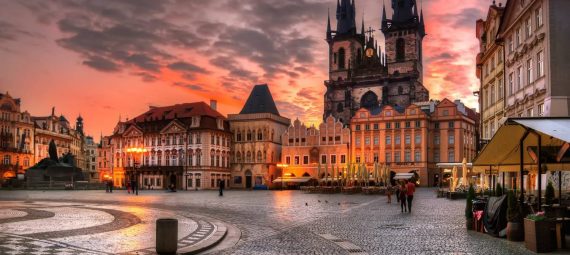
Below are nine must—visit places in Eastern Europe that will awaken your craving for travel – and, perhaps, inspire you for your next trip.
Riga, Latvia
The capital of Latvia, which has the world’s largest collection of Art Nouveau architecture, is just a dream for connoisseurs of culture. Going on a walking tour through the cobbled alleys of the Old Town, you will see almost 800 buildings in this style: from Riga Art Nouveau buildings, complemented by goddesses and gargoyles, to pastel facades with wooden decorative trim. Soak up this atmosphere by staying at the 38-room Hotel Bergs, which occupies two buildings built in 1895 and is just a stone’s throw from the most fashionable restaurants and coffee shops in Riga. Be sure to check out the Innocent Café, a favorite of locals, located right around the corner.
Albanian Riviera
The beaches of the Albanian coast of the Ionian Sea dotted with umbrellas can be confused with the south of France or the Amalfi coast of Italy in the blink of an eye. However, there is one significant difference: The so-called Albanian Riviera remains a secret destination for beach lovers who want to avoid crowds and biting prices. Start the tour in Saranda, the unofficial capital of the region, which sheltered a 16th-century castle and a fifth-century synagogue, as well as the most beautiful beach. Then head to lesser-known cozy towns: Ksamil near the Greek border; Borscht, a quiet area with hills dotted with olive groves; and the village of Himara, where the Soleil Village Hotel on Jal Beach overlooks turquoise waters and the Mediterranean-style Folie Marine beach resort.
Dubrovnik, Croatia
Most likely, you have already seen the stone-paved paths and medieval fortifications of Dubrovnik on the screen: the walled city played the role of the Royal Harbor in Game of Thrones. Personally, these places are even more incomparable. There are many shops in the Old Town selling traditional lace and embroidered products, but if you want to take a break from the hustle and bustle, head to the Tristen Arboretum, a Renaissance garden with exotic plants and trees. Rest your feet at the Hotel Excelsior, where Queen Elizabeth II and Elizabeth Taylor stayed and which owns a private beach on the Adriatic coast.
Lake Bled, Slovenia
A 40—minute drive along the picturesque serpentine – and now you are far from the stone-paved alleys of Ljubljana on the rocky shores of Lake Bled, a serene place, as if descended from the pages of a fairy tale. Surrounded by the Julian Alps, this lake appears in all its Tyrolean splendor: rocks hold a castle in their arms, and a picturesque church is located on a tiny island in the center of the lake. The Vila Bled Hotel is always full of newlyweds and romantics, but there is also something for adventurous people to do here. Put on hiking boots and go hiking along the forest trails of Triglav National Park or to Slovenia’s largest waterfall in the Vintgar Gorge.
Krakow, Poland
Often undeservedly overlooked compared to Warsaw, this second city in Poland is also one of the oldest cities with a historical center that can compete with many cities in Western Europe. The Gothic-style Mariacki Church looms over the largest square on the continent and atmospheric cobbled streets and medieval structures dating back to the 13th century. Head south to see the Italian Renaissance paintings at Wawel Castle, the former residence of the royal family, turned into a museum in the 1930s. Not far from the city there is a salt mine in Wieliczka with underground lakes and bizarre salt sculptures, and the ruins of Auschwitz and Plaszow serve as a reminder of the Holocaust that the country had to go through.
Plitvice Lakes, Croatia
Croatia’s oldest national park is also the most impressive: 16 pristine waterfalls pour their waters into emerald-green lakes and ponds. Wooden decking provides an opportunity to explore them all or walk through the dense forest surrounding this UNESCO World Heritage Site. Go there in the fall to avoid the crowds of tourists, because this park is visited by up to 15,000 people. Here, just a day’s drive from the Croatian capital Zagreb, there is also an Art Deco gem – the Esplanade Hotel, built in 1925 and hosted Ella Fitzgerald, Sophia Loren and Orson Welles. Leave your belongings and head to the lively restaurants and cafes on Tkalcic Street.
Bay of Kotor, Montenegro
In the last decade, Croatia has appropriated all the tourist glory, and the pink sand beaches and ancient villages of Montenegro have remained almost unnoticed. Head to the coast of the Bay of Kotor to see the best places in the country — from primitive mountains and forests to cobalt-blue waters and beautiful architecture. The town of Kotor at the foot of Lovcen Mountain has been around for 2,000 years and attracts attention with its traditional ceramic roofs, historical walls and Venetian palazzi that are hundreds of years old. The tiny town of Perast, located a 15-minute drive north, impresses with its ruins and churches, two of which are located on islands near the coast. Spectacular Tivat is an ancient naval base, recently converted into a yacht parking lot just like in Monaco, and watching people here is just as interesting.
Viticulture areas of Hungary
While European wine lovers continue to make pilgrimages to Italy, France and Spain, dedicated fenophiles have added Hungarian wine regions to their itineraries. The tiny village of Eger, located just two hours by train from Budapest, is notable not only for its cobbled streets and 13th-century castle, but also for the red wine “Eger bull’s blood”. Try the best local varieties from the cellars of the Valley of Beauties, and then leave your belongings at the Grof Degenfeld Castle Hotel and head further west to Tokai, famous for its sweet Asu wines.
Tatras, Slovakia
If the high cost has closed the way to the Alps or Dolomites for you this ski season, go to the slopes of the Slovak Tatras in the Carpathians. Of course, they will never compare with the luxury of Gstad or Mezhev, but in Yasna, a small resort in the Low Tatras, you will find modern ski lifts, well-groomed territory and 42 kilometers of ski trails bordered by snow-covered pines, not to mention the absence of a crowd of tourists. Something similar to Tyrolean hospitality awaits you at the Grandhotel Kempinski in Stari Smokovets in the High Tatras. Visitors who prefer to travel in summer will be able to enjoy alpine meadows, caves and ancient pine forests in four of Slovakia’s nine national parks.