
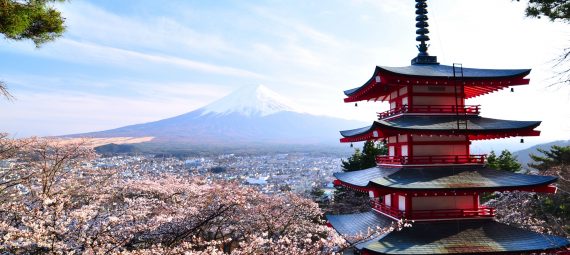
Japan is not the most popular destination for tourism, but it is an amazing country full of contrasts and contradictions. Here life flows rapidly and at the same time the influence of traditions is strong, nature gives peace and tranquility. Experienced travelers who have visited more than one country before come here more often.
Mount Fuji
If we consider the natural attractions of Japan, then Fuji is the main one. The Japanese consider it sacred and therefore build temples on the slopes. It is located 100 km from Tokyo, but despite this, its peak with a cap of snow is visible from the capital. This is a weakly active volcano, the last eruption of which was more than 300 years ago. You can climb to the top of Fujiyama in about 6 hours, but the mountain is open to the public only in the summer months (except June). Tourists who are determined to conquer this height should take care of warm shoes and clothes – it is cool on the mountain, despite the summer.
Sagano Bamboo
Grove It was created in the 14th century by the Japanese poet and monk Muso Soseki. This is a kind of alley formed by slender tall bamboo trees, a mysterious, slightly fabulous, fascinating world. Charming music sounds here all the time, born from the contact of the wind with the bamboo stem. These sounds are soothing, give peace. The Japanese believe that bamboo protects people from evil spirits. The area of the grove (or, as it is also called, bamboo forest) is 16 square kilometers, there are many walking paths. Bamboo grows very fast: it only takes a month to reach the 20 meter mark. The height of some stems is even 40 meters, and the diameter is more than 30 centimeters. In addition to bamboo, there is a pond in the grove, on the left side of which there are temple buildings. It takes only half an hour to get here from Kyoto.
Blue pond on the island of Hokkaido
Remembering the most striking sights of Japan, it is impossible to ignore this reservoir. It appeared at the end of the last century and got its name due to the saturated shade of water. The dazzling blue of the water surface enchants, you can look at it endlessly, from different angles it seems dark, then light, transparent. Scientists say that the pond water is saturated with aluminum salts, which give it a unique shade. The contrast of the blue water surface is the dried tree trunks sticking out of it. The pond is especially beautiful in winter, under a thin crust of ice and light first snow it looks magical.
Hitachi National Park
It is located in the city of Hitatinaka on the shores of the Pacific Ocean. This is a unique place: it changes color every season, and therefore it is interesting to come here at any time of the year. The park has a huge territory filled with various flowers: lilies, tulips, daffodils, poppies, sakura, forget-me-nots grow here. Each plant colors the park in its own color, spreading endless carpets of yellow, pink, blue, green and other shades.
Ogasawara National Park
It is located on the islands of the same name, between the subtropics and the tropics. It is the southernmost Japanese national Park. It is not easy to get here: the sea route from Tokyo will take more than a day (about 30 hours), but you will not have to regret the journey you have undertaken: the natural attractions of Japan in these places are simply charming. The islands of volcanic origin, covered with dense forest, created by nature itself, have bizarre outlines, cliffs rise above the water surface. All this creates unique conditions for the existence of a rich world of flora and fauna.
Ishigaki Island
A paradise for divers and beach lovers. There is everything here: the blue sea, snow-white sand, mangrove forests, rocks, as well as corals with amazing wildlife. You can snorkel or hire a boat with a transparent bottom. The island is part of the Yaeyama Archipelago and is washed by two seas at once: the Philippine and East China Seas.
Happo–en
The popular Tokyo garden, which is rich in the capital of Japan. This is a kind of charming corner of nature in the middle of a bustling city. Its name means “garden of eight landscapes“ in Japanese. Not only tourists like to come here, but also Tokyites themselves – to walk in the shade of trees, sit on the shore of a pond, listen to the murmur of a stream and escape from the hustle and bustle, festive events (banquets, weddings) are also held here. The garden is already 400 years old, during which time it has had many owners who have changed it in their own way. Today, tea ceremonies are held here, and a restaurant is open.
Jigokudani Snow Monkey Park
A unique place that attracts many travelers. The park, located near Nagano, was opened in 1964. Here you can observe the behavior of funny monkeys and take interesting photos. Snow monkeys are called that for a reason – they are not afraid of the cold, they easily withstand frosts up to -15 degrees. In winter, whole families bask in hot springs, as if in baths, and in summer they jump merrily through the trees, so you can come here at any time of the year. Macaques are not afraid of visitors, there are no cages and barriers, this is a unique opportunity to observe animals in natural conditions.
Fuji–Hakone–Izu National Park
It is located on the island of Honshu. It was founded in 1936, its area is more than 1000 square kilometers. The main local attractions are Mount Fuji, thermal springs, lakes, including five famous reservoirs surrounded by hills, islands of volcanic origin, covered with bright tropical vegetation.
Sakura Park is located on the Izu Peninsula, which is worth visiting for those who came to the country in the spring. There are excellent conditions for recreation: beautiful beaches with coves, all conditions for diving, hot springs.
Todaiji Temple
Located a short walk from the city center, in a park, it is the most popular tourist attraction in Nara and a UNESCO World Heritage Site. Todai–ji, as well as Kofuku–ji and Horyu–ji make up the “Big Three“ that must be visited in Nara. This is a city where interesting sights of Japan are collected, there are more than 500 holy places for the Japanese. Todai–ji Temple is a complex of buildings that includes the world‘s largest wooden structure, built in 743, which houses a gilded 15–meter bronze statue of the Great Buddha, cast in 749.