
 Events
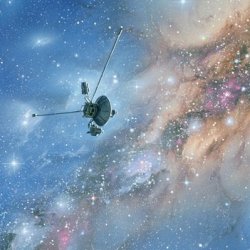
The Voyager 1 spacecraft officially became the first human-made object to leave the solar system.
NASA scientists have confirmed that the spacecraft has finally escaped from the Sun's gas bubble and made it to interstellar space, the cold, dark region between the solar systems.
Voyager 1 was launched in 1977 to study the outer planets, and then it just kept moving. The spacecraft is now 19 billion kilometers from the Sun.
This distance is so vast that it takes 17 hours before the radio signal sent from Voyager 1 is received on Earth.
According to NASA, the probe crossed interstellar space on August 25, 2012. Scientists know this because plasma or ionized gas in interstellar space has a higher density than solar plasma. The probe passed through dense interstellar plasma for about a year.
Scientists have been waiting for this historic moment for almost 40 years.
“From a scientific point of view, this is a key event, and from a historical point of view, it is like traveling around the world for the first time or leaving your mark on the moon. This is the first time we've started studying the space between stars,” said Professor Ed Stone.
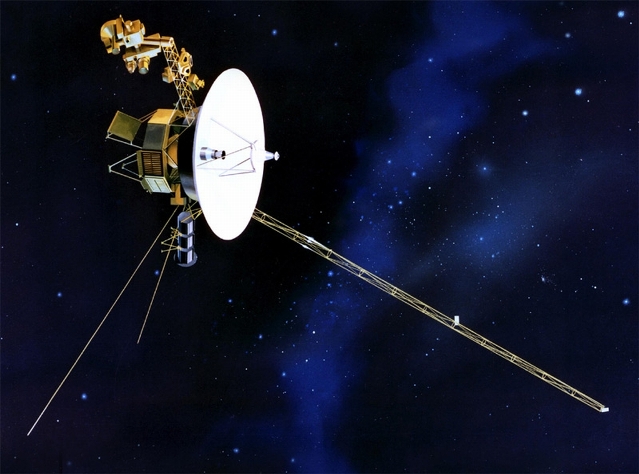
Although the spacecraft is now surrounded by gas, dust, and magnetic fields from other stars, it still feels the Sun's gravitational pull, as do many comets even farther away space. But anyway, he left what most people define as the Solar System.
Voyager 1 Way
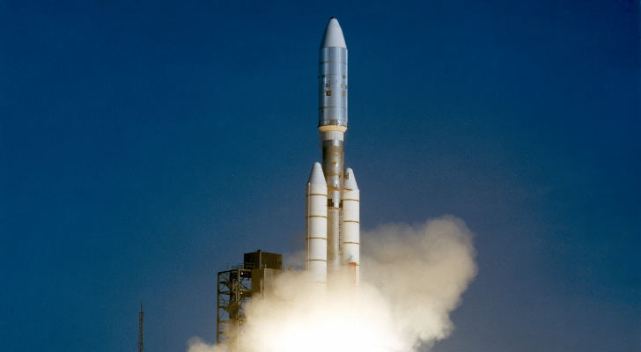
– Voyager 1 was launched from Earth on September 5, 1977, and before that, on August 20, 1977, the Voyager 2 probe was launched.
– Their official mission was to study the planets Jupiter, Saturn, Uranus and Neptune, which was completed back in 1989. They then went into deep space.
Voyager 1 discovered a new region on the edge of the solar system
– Scientists expect that Voyager will be able to work for another 10 years, after which its instruments and transmitters will become unusable.
– Voyager 1 will reach the next star in about 40,000 years, despite traveling at 45 meters per second.
– It will be orbiting the center of our Galaxy with stars for billions of years to come.
– The new area Voyager is now flying through is being created by large stars that exploded millions of years ago.
Voyager 1: the sound of interstellar space (video)
Voyager 1 sent a recording of sounds that are heard in the dark of space 19 billion kilometers from the Sun.
Voyager 1 collects a variety of data in space, including sounds. His plasma wave instrument recorded vibrations in dense interstellar plasma in October—November 2012 and April—May 2013.
The graph shows the frequency of the waves, that is, the density of the plasma. The colors indicate the intensity of the waves, or how “loud” they are. Red is the loudest wave, while blue is the weakest.
The structure and boundaries of the solar system
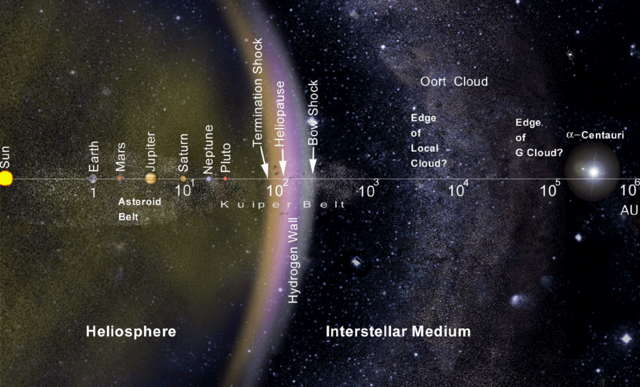
Solar system, heliosphere, Oort cloud, Alpha Centauri
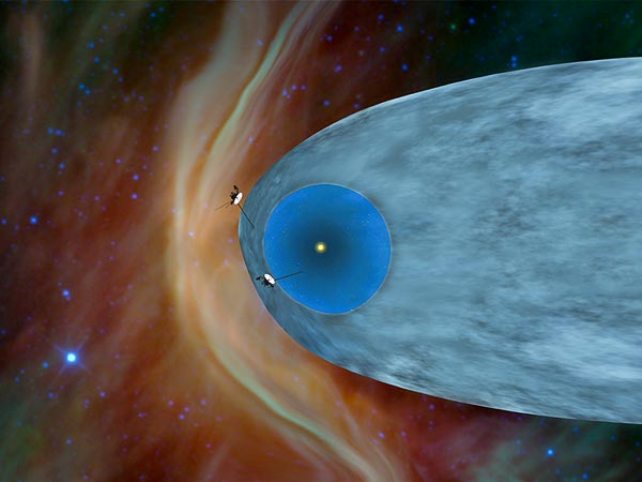
The sun is in a bubble of hot gas called the heliosphere.
The solar wind is a stream of charged particles that come from the Sun and move at supersonic speed.
The shockwave boundary is the area where particles from the Sun begin to slow down and collide with matter from deep space.
The heliospheric mantle is a huge turbulent space where the solar wind is compressed due to the pressure of interstellar matter.
The heliopause is the boundary between the solar wind and the interstellar wind, where the pressure of both is the same.