
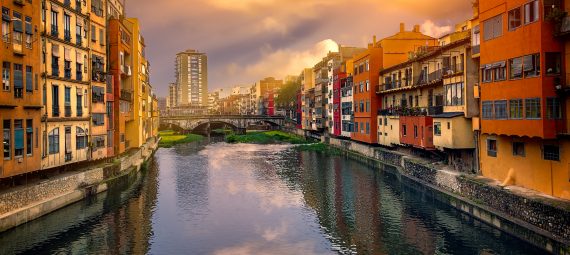
Il-Col in Girona
Almost all tourists who come to the city come to the Jewish (or, more precisely, the once former Jewish) quarter of Girona. There is nothing surprising here: such a degree of preservation is a great rarity even for the pampered sights of Western Europe.
Girona Cathedral
The local cathedral is considered the hallmark not only of Girona, but also, perhaps, of the entire Costa Brava. During its existence (and the temple was built around 1312), the cathedral was rebuilt several times.
The walls of Girona
Like many other cities in the Mediterranean, Girona is a very old city. But in addition, Girona was located not only close to the coast, but also on the main road in the region, built under the Romans, which connected the major cities of Spain with the coast, and then with Rome, the capital of the empire.
Arab baths in Girona
The Arab baths in Girona are one continuous contradiction: they are called “Arab” — but they have nothing to do with Arabs or Arab countries, an institution for recreation, and in architectural style clearly resembles a church, a public bath — and in a monastery.
Episcopal Palace in Girona
The Episcopal Palace of Girona is very well preserved, and this is not surprising: it was used for its intended purpose right up to 1976, when it was transferred by the church to the city of Girona to organize a museum in it.
Monastery of St. Dominic in Girona
The building of the monastery of St. Dominic is somehow very organically combined with the organization that occupies it now. It’s simple: the Faculty of Arts of the University of Girona has settled in its buildings, which were started in the 13th century.
The Monastery of St. Peter Galligans in Girona
The monastery of St. Peter was founded in the 10th century, when the local ruler, the Count of Barcelona, donated this piece of land to the Benedictine Order. There has never been a large monastery, so it was combined with larger monasteries several times.