
 Incredible facts
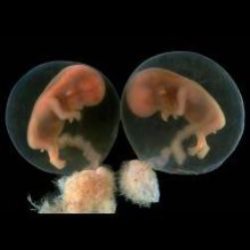
Monozygotic or identical twins are the only people in the world whose genotypes are almost identical. Twin embryos are formed from one zygote, which is divided into two or more parts. Since ancient times, when people had no idea about genetics and anatomy, they believed that having twins was something special. The twins were endowed with both magical, miraculous powers, and diabolical features.
For example, American Indians believed that one twin in a couple was always good and the other was evil, so the “evil” twin was expelled from the tribe. The Slavs believed that twins had one soul for two, so the presence of one twin at the wedding or funeral of the other was not allowed. Many cultures believed that twins could protect against the weather. Apparently, the mere appearance of twins was considered a whim of nature, so it was believed that they could cope with it. Indian shamans painted twins black and white during rituals.
Modern geneticists obviously don't do anything like this. However, they are also very interested in studying monozygotic twins and love to conduct various studies with them. This is truly a gift from nature, which provides a unique opportunity to find out where environmental influences end and genetic predestination begins.
 A proposal to study twins first came from the English scientist Francis Galton in 1875. His cousin Charles Darwin supported his brother: “Nothing seems more interesting to me than the similarities and differences between the twins.” As a result, twin studies began to be conducted to study the likelihood of developing diseases, forming personality traits, physical characteristics, etc. genotype, and differences by environmental influences. However, it's not that simple.
First, not so long ago, scientists were able to find that even the genomes of identical twins have some differences. In 2008, an international team of scientists from the United States, Sweden and the Netherlands concluded that identical twins are genetically different. Experts analyzed the genomes of 19 pairs of identical twins and found enough differences in some copies of DNA in somatic cells. In general, the twin genomes were very similar, however, experts found some differences in each pair.
Another difficulty is that most siblings were brought up in a very similar environment as they grew up together, played with the same toys, went to the same school etc. The twins may have liked different writers, but their parents read them the same books, they probably liked different foods, but mom and dad fed them the same food. Of course, it would be inhumane to forcibly separate the twins in order for them to live in different environments. However, sometimes life often divides them against their will.
 Sometimes twins find that they have different interests and professional inclinations. They choose different schools, study different professions, develop their own social circle, and each of them creates their own living environment. It happens that siblings are separated by historical events or family dramas, such as the death of parents. This was not uncommon in the 20th century during World War II. Lost children and children of parents who died in the war were adopted by different families. To this day, stories of elderly twins who were born in those years, lived apart all their lives, and united only at the end of their lives, are not uncommon in the media.
One of the largest studies on twins was conducted in the early 1980s by American psychologist Thomas Buchard. Overall, he studied 30 twin pairs separated at an early age. One of the twin pairs studied was the monozygotic brothers Oscar and Jack. The boys were born from a marriage between a Jew and a German woman. Shortly after the twins were born, the couple split up. The mother took Oscar home to Germany, where she hid the fact that the boy was of Jewish blood for a long period of time. Oscar later joined the Hitler Youth youth organization and became a devoted Catholic. Jack spent his childhood and youth with his father, first living in Palestine and later moving to an island in the Caribbean. The boy was raised in the Jewish tradition.
The brothers met when they were over forty years old. Incredibly, despite their radical differences in education, places of residence and languages of communication, they had surprisingly much in common, both in habits and characters. They had similar temperaments, preferred the same style of dress, loved the same food, wore similar glasses, and even straightened their mustaches in the same way. Moreover, their communication styles in their families were very similar.
 Sisters Lois and Louise are another prime example. The girls were born in 1920 and were separated shortly after birth. They began to live with different families. Education levels and places of residence varied: Louisa lived in a small town and attended a local, very simple school, while Lois grew up in a big city and attended a very prestigious school.
It should be noted, however, that the economic and cultural statuses of the families in which the girls grew up were similar. This may be the reason why girls aged 18 went to the same college. The researchers noted that in terms of the number of similar physical and psychological traits, this pair of twins was very close. The girls shared even more in common than the twins who grew up together.
There is also a funny example when two American twins separated as children chose a very narrow “professional specialization” independently of each other. They became safe breakers. However, scientists draw conclusions about the role of heredity with great caution. For example, it was found that 50-70 percent of monozygotic twin pairs have very similar criminal histories, and twins (genetically considered to be ordinary siblings) share such similarities much less often — only in 20 per cent of cases. However, some studies contradict these data.
Researchers have identified some peculiarities that are most likely caused by genes. Nancy Peterson, a Swedish scientist, found that the level of extroversion and introversion of a person is largely determined by heredity, as well as the level of neuroticism (emotional instability). In general, scientists agree that many features of an organism depend not only on the genotype and habitat, but also on their interaction with each other. However, hemellology, the science of twins, continues to evolve and occupy the minds of researchers.