
The audience goes to the theater not only to listen to opera or watch ballet.
Sometimes the building itself is worth it to come there and see the magnificent facades and luxurious interiors with huge chandeliers.
Almost every country has a theater, which is considered one of the main attractions of the region. As a rule, it is located in the capital or the city — the cultural center of the state.
Grand Opera in Paris
Theater address: Pl. de l’Opéra
Year of foundation: 1875
Repertoire: opera, ballet, concerts
In 1858, an attempt was made on Napoleon III near the Le Peletier Theater. It turned out to be unsuccessful, but the emperor did not want to appear there again and ordered the construction of a new opera house in Paris — the Grand Opera. It is also called the Opera Garnier and the Paris Opera.
The building was designed by architect Charles Garnier and built in the Beauzard style. The stones for the construction of the Grand Opera were brought from all over Europe and Africa. The works were carried out from 1860 to 1875.
One of the most beautiful places of the theater is the grand staircase. It was laid out with marble of different colors, and at its foot there are sculptures of women holding lamps in their hands. The theater foyers were decorated with golden mosaics and mirrors, which, together with the windows, create a sense of spaciousness.
A special attraction of the theater is the ceiling, which was painted by Marc Chagall in 1964. The artist divided it into several sectors, each of them depicting scenes from famous operas and ballets: “Swan Lake”, “Boris Godunov”, “Romeo and Juliet”, “Tristan and Isolde”.
The theater became the setting for Gaston Leroux’s novel The Phantom of the Opera. The book mentions a mysterious underground lake. The Grand Opera was really built on a swampy area: underground water makes the foundation more stable and serves as a reservoir in case of fire.
In 2000, the facade of the theater was updated, and at the end of the 2000s, beehives were installed on the roof. Honey is collected from them.
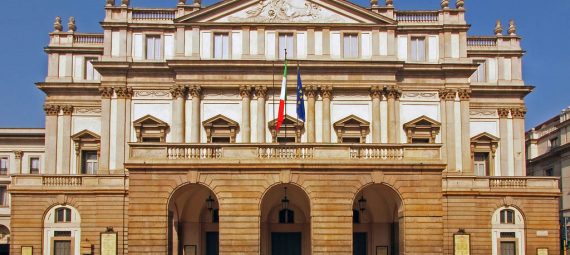
La Scala in Milan
Theater address: Via Filodrammatici, 2
Year of foundation: 1778
Repertoire: opera, ballet, concerts
The most famous Italian theater opened in 1778. It was built on the site of the church of Santa Maria della Scala – hence the name. During the laying of the foundation, a fragment of marble with the image of the ancient Roman mime Pylades was found in the ground and considered it a good sign.
Architect Giuseppe Piermarini maintained the neoclassical style. The facade of the building was decorated with a portal for the entrance of carriages. The hall was decorated in white, silver and gold tones. There was another row behind the boxes where people gambled and bought drinks. Many spectators spent all the time there while the performance was going on. Initially, there were only chairs in the stalls, and molten wax dripped onto the audience from candles at the top.
The heyday of the theater is associated with the name of the conductor Arturo Toscanini, who came here in 1887. He was the first to put Wagner on the Italian stage, and also brought order to the auditorium: he forced the ladies to leave their hats in the wardrobe so that they would not interfere with those sitting behind. Thanks to Toscanini, the curtain began to rise not up, as before, but to move apart: the conductor did not like that the audience first of all sees the performers’ legs.
During the Second World War, the building was destroyed. The theater was reopened in 1946, and Toscanini conducted the first concert. He even donated a million Italian lira to restore his beloved theater.
The next restoration took place in the early 2000s, it was led by Mario Botta, an architect from Switzerland. During it, the stage was enlarged and the visual spaces were reduced. In 2004, the theater reopened with Salieri’s opera “Recognized Europe”, as in 1778.
Vienna State Opera
Theater address: Opernring, 2
Year of foundation: 1869
Repertoire: opera, ballet, concerts
The Court Opera has existed in Vienna since the 17th century, but a separate building began to be built only in 1861 and opened in 1869. Its facade was decorated with arches, columns, sculptures by Ernst Henel.
Now sightseeing tours of Vienna are starting from the theater building, but the 19th-century public did not like the neo-Renaissance building. He was called too squat and heavy, compared to a sinking box. This was due, among other things, to the fact that after the construction of the theater, the street level on which it stood was raised by a meter. Because of this, it seemed that the building was growing into the ground. The Emperor of Austria Franz Joseph the First joined the number of dissatisfied. One of the architects, Eduard van der Null, could not stand the wave of criticism and committed suicide.
Bombing during World War II partially destroyed the building, but by 1955 it was restored and the tradition of annual balls was resumed. They are held on the eve of the beginning of Lent, a month and a half before Easter. Unesco has listed the Vienna Balls in the list of intangible cultural heritage.