
There are many ancient cities in Turkey. In most of them you can see the heritage of three epochs from the 4th century BC to the 11th century of our era: Hellenistic, Roman and Byzantine.
To our surprise, we managed to walk alone in Ephesus, which welcomes thousands of tourists every year. In the deserted Miletus, they walked right on ancient pottery shards. The Temple of Apollo in Didymus with huge columns 20 meters high inspired an almost religious feeling, and the Lycian tombs in the rocks of Mira struck with their elegant forms. Olympos, whose ruins are hidden in the forest, is just a dream of Lara Croft, although it would be better if she didn’t steal anything here.
Where it is located: 4 km from Selchuk, 75 km from Izmir.
Opening hours: from April to October — from 08:00 to 19:30, from November to March — from 08:30 to 17:30, ticket offices close an hour earlier.
How much does the entrance cost: 120 TRY, another 55 TRY — if you decide to explore the houses with terraces.
Additional expenses: parking for the whole day — 20 TRY, audio guide — 70 TRY , as a deposit, you will be asked to leave your passport.
The ancient Greeks founded Ephesus in the 10th century BC on the shores of the Aegean Sea. After that, the port city went to the Romans, then to the Byzantines. He moved several times after the shallowing sea. Under the Ottomans, in the 15th century, Ephesus, which was badly damaged by earthquakes, was abandoned. The first excavations here were carried out by an English archaeologist in 1869: he searched and found the temple of Artemis.
The archaeological complex “Ephesus” is located on an area of 10 km2 and is one of the ten most popular historical attractions in Turkey. To avoid crowds, it is necessary to arrive early, preferably by the opening.
Visitors enter the city through the upper or lower entrance. The first one is more popular, it is chosen by guides with organized groups. Tourists go downhill all the time, and you don’t have to come back: a tour bus will pick you up at the bottom. Independent travelers also often choose the upper entrance, because the audio guide route begins there. But we arrived at the bottom, where there were no people at all.
Here we took audio guides. These devices are phones that can be used without headphones, but I do not advise doing this, because sometimes it is very noisy on the route. Although some tourists take one audio guide for two — it turns out to save 70 TRY .
Just imagine: millennial streets, a theater, a shopping area, around them are mountains that have not changed since then, and you, and absolutely alone. Here you can take photos, slow down to the speed of the ancient Greeks and look at the inscriptions on boulders that were scratched by ancient vandals.
We managed to explore half of Ephesus without outsiders, until we encountered several dozen, and a little later hundreds of other visitors. Then we decided to go up to the upper entrance and inspect everything in order.
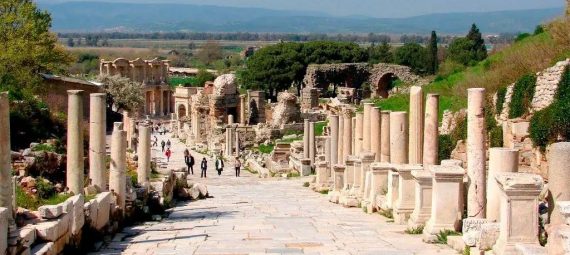
At the entrance there is an agora — a shopping area, next to it is a Small theater, or Odeon, for 1400 seats, where the city senate met. We did not linger here and immediately went up to Kuretov Street. It is easy to recognize: here is the highest concentration of ideal places for photos.
The current appearance of the street was given in the 4-5 centuries, when it was restored after the destruction from an earthquake. There are columns and pedestals on both sides. Previously, there were trading shops, residential houses of noble citizens, the temple of Hadrian, the fountain of Trajan, baths and a public toilet. An audio guide will help you find them on the spot, there are signs next to some ruins.
There is a Celsus library at the end of Kuretov Street, you won’t be able to miss it: there are a lot of people at the 16-meter facade, which resembles a theatrical scenery. The library with 12,000 scrolls at that time was the second largest after the Alexandrian One. But, like the Alexandrian one, it burned down in the 3rd century, only the facade survived. In the 1970s, the monument was restored: all its preserved parts were collected and put in its original place. But four female sculptures were replaced with copies, the originals are in the Ephesus Museum in Vienna.
At the request of “Ephesus”, search engines give out photos with the Celsus library. Before the trip to the ancient city, these images did not impress me. On the spot, we spent at least half an hour: on the square at the entrance, we looked at the decor, columns, and just the sky in the gap of empty window openings.
To the right of the library is the lower agora. To get there, you need to go through the gates of August. Almost all tourists with audio guides here go to the right aisle and start looking for something. When we heard the description of this attraction to the end, we also went to look. It turned out that finding a phrase in ancient Greek that means “Whoever urinates here will be put on trial” is unrealistic, but it’s easy to laugh with other tourists.
Beyond the lower shopping area there is a Large Theater with 25,000 seats. The Greeks used it for performances, and the Romans turned it into a stadium and organized sports competitions here. I advise you to climb to the top rows for the sake of a memorable look. Be careful: some steps are crumbling.
After the theater, we went to the houses with terraces of the 1st century. Despite the fact that the buildings stood on top of each other and resembled a high-rise building collapsed on a hill, they served as housing for the rich. The premises are protected by a covered pavilion, which simplifies restoration work. It is no longer possible to pass your hand over the walls: they have priceless murals. You can only walk on floorboards and glass spans, because the floor is decorated with unique mosaics.
If you take an audio guide at one of the entrances, you need to exit through it to pick up your passports from the deposit. That’s what we did: we walked from the lower entrance to the upper one and back.
If you get tired, you can take a taxi from one entrance to the other. The trip will take 5-7 minutes and will cost 25-30 TRY. Cars drive on the road outside the territory of the archaeological complex. Taxi drivers are waiting for passengers at the entrances.
We spent 3.5 hours in Ephesus — it turned out to be enough not to have time to get fed up with others, but also not to get tired to indifference. Moreover, I wanted to go to a couple more places in Selchuk.
The Temple of Artemis of Ephesus, which was built in 550 BC, is located a few kilometers from any of the entrances to the archaeological complex. The vain Herostratus of Ephesus went on arson to become famous. Because of him, the temple of Artemis suffered. A little later it was restored in its former form, but in the 5th century it was abandoned.
From the temple there were blocks scattered across the wasteland, and a column that seems to have been assembled from parts of others. Most of the fragments are kept in the British Museum in London and the Archaeological Museum of Istanbul. It is worth coming to the temple for intellectual pleasure: after all, it is one of the seven wonders of the world. You can inspect it for free, the working time is not limited.
St. John’s Basilica. 2 km from the Temple of Artemis and 4 km from the complex “Ephesus” is once one of the largest buildings of Byzantium – the Basilica of St. John. It was built in the 6th century on the burial place of the Apostle John the Theologian. There are ruins left of it — you can imagine the size of the basilica by them. I recommend that believers come here, but other tourists may be bored. The entrance to the temple costs 30 TRY.
Judging by the reviews on the Internet, many travelers still visit the archaeological museum of Ephesus, where finds from the excavations of the ancient city are stored, including the most famous — the statue of Artemis from her temple. They say that the exposition is decent, it is worth putting at least 2-3 hours on it. The ticket price is 30 TRY . Our time was limited, and instead of a museum we chose a temple and a basilica.