
 Incredible facts
Sometimes scientific discoveries are too good to be true. Any of them gets a lot of press coverage, scientists make loud statements, and then it turns out that there was a lot of ado about nothing. Outstanding discoveries require irrefutable evidence.
According to Art Caplan, bioethicist at the University of Pennsylvania, all scientists dream of a major discovery, but in fact, there are only claims that require proof. The fact is that research requires more and more money, and scientists believe that a little bit of advertising will help them attract sponsors. But their significant discoveries are not always true.
Habitable planet
 The newly discovered planet in the Gliese 581 solar system in the Libra constellation has caused a lot of controversy. It was believed that it may well be habitable, as it is located in a habitable zone, just at the right distance from its star.
And so, this week, a group of Swiss scientists announced that they were looking at this solar system, but they did not find the planet…
Sara Seager, a professor at the University of Massachusetts, said she was impressed with the Swiss report, and the Americans were quick to announce the discovery of a new planet.
According to Seeger, the irony here is that three years ago, the Swiss themselves should have mistaken the fact that they discovered a planet in the Goldilox zone.
She also adds that these mistakes will be a disservice to astronomers, as no one will believe them next time.
Cold nuclear fusion
 In March 1989, two scientists, Stanley Pons and Martin Fleishmann, announced that their “cold fusion” experiment had been successful.
Cold nuclear fusion is a reaction that releases heat when heavy water and palladium interact at room temperature.
At a press conference, scientists said that this process would be a source of cheap energy, and the press called them “brilliant inventors”.
However, researchers from other countries were never able to replicate this experiment, and the Department of Energy, which funded the study, denied Pons and Fleischman's claims.
Vaccine and autism
 In 1998, the Lancet medical journal published a report by Dr. Andrew Wakefield, according to which autism in children was caused by a vaccine against measles, mumps and rubella.
Vaccinations have fallen across Britain and the US, and Wakefield has become a hero for parents.
Referring to the results of the Wakefield study, parents demanded that thimerosal, which contains mercury, be removed from vaccines. But even after such a measure, the number of children suffering from autism has not decreased.
People applied for compensation and asked the government to enact appropriate laws, despite the fact that numerous studies have not found a link between vaccination and autism. Moreover, the refusal to vaccinate has led to an outbreak of certain diseases.
In February 2010, British medical experts concluded that Wakefield was dishonest and violated basic ethical standards in conducting the study, and in April he was taken away from him license.
Life on Mars — 1
 From science fiction writers to ordinary citizens, everyone hopes that somewhere there is a planet with an atmosphere and water that also has life.
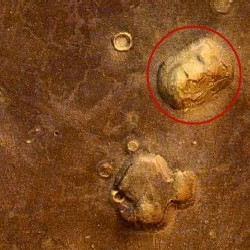
In this regard, Mars seems to be the most attractive planet. In 1976, humanity seemed to have proof of life on Mars when NASA's Viking spacecraft photographed the so-called “face of Sidonia”.
There were a lot of assumptions: a temple of an ancient civilization, a statue of a pharaoh, etc. But as technology improved, NASA cameras also improved. In 1998, new high-resolution cameras photographed the same place in the Sidonia area.
The “face” turned out to be a dilapidated cluster of stones. In 2003, it was discovered that it was a flat hill.
Life on Mars 2
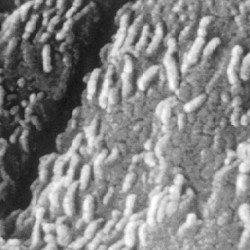 In 1996, new “proof” of life on Mars appeared.
Traces of ancient bacteria were found on the rock that came off the surface of Mars after the planet collided with an asteroid and fell into Antarctica 13,000 years ago. Scientists announced that they had presumably found signs of life on Mars and named the meteorite ALH 84001.
However, not all scientists supported this theory, arguing that these traces were the result of inorganic processes. Even after NASA published a 2009 report that found these traces were of biological origin, critics remained unconvinced.
One of them, Michael Fuller from the University of Hawaii, says the marks on the rock may have appeared when it entered the Earth's atmosphere.
The missing link
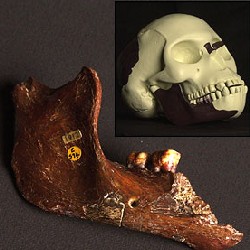 Paleontologists have long been looking for the so-called “missing link” between humans and great apes, so each find is carefully checked. However, paleontologists have not yet made a greater mistake than in the case of the Piltdown Man.
In 1912, amateur archaeologist Charles Dawson found human jaws and bones in Sussex, England, and took them to the British Museum. They announced that these bones were the remains of a “missing link”.
The find was criticized immediately, but withstood attack until 1953, when, using more modern technologies, scientists found that they were the remains of an orangutan and modern man.
There have been other cases: for example, in 1999, paleontologists allegedly discovered the missing link between birds and dinosaurs — the archaeoraptor, but in fact the find consisted of two different skeletons.