
 Useful tips
Content:
Children's bicycles from 1 to 3 years old
Balance bike for children from one year old
Tricycle for children from 1 year old
Tricycle for children from 2 years old
Children's bicycles from 3 to 5 years old
Children's bicycles from 6 to 9 years old
Bicycles for teenagers
This article is intended for parents who intend to buy a bicycle for their child, but are hesitant due to ignorance of the nuances of choosing.
In it, we do not give advice on choosing bicycle brands — now there are a huge number of manufacturers on the market that make quite good models.
On the other hand, we provide an opportunity to find answers to other important questions.
What should you focus on first? Should I unconsciously believe the tables that suggest choosing the thickness of the wheel depending on the height and age of the child? When to put a child on a two-wheeled bike?
We read and get answers to these and other questions.
Children's bicycles from 1 to 3 years
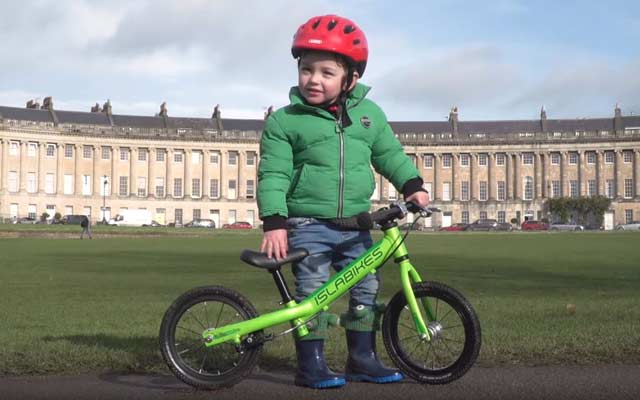
This age group of the youngest cyclists is almost always considered separately for a reason. The fact is that at the age of one to one and a half years, almost all children
begin to walk. And it is at this age that it is strongly recommended to buy not some banal walker, but a balance bike.
Running bike for children from year to year
A balance bike is a hybrid of a bicycle without pedals and a scooter. Externally, the balance bike is a small two-wheeled bike without pedals, and the principle of riding it is the same as riding a scooter: the baby learns to ride and keep balance, pushing his feet off the floor .
One of the advantages of your baby starting to explore the world of bicycles with a balance bike is that this will allow him to quickly learn how to ride a two-wheeled bike later. And in this sense, a balance bike is even better as a first bike than a bike with two additional rear side wheels.
A balance bike for the little ones
For the youngest children who have barely learned to move, you can initially purchase a four-wheeled balance bike, which, of course, cannot keep the balance is required. For babies under one and a half years old, it is better to choose a lightweight plastic balance bike.
Bike frame
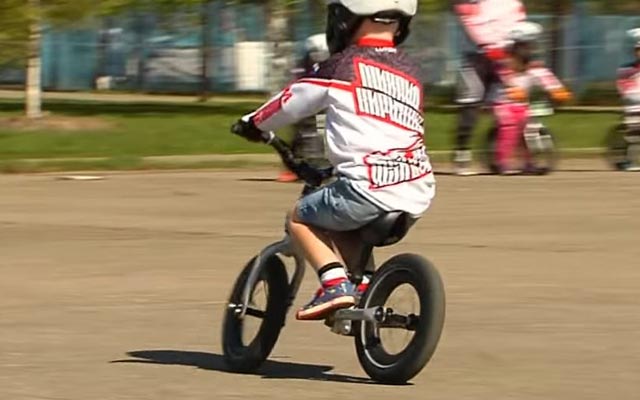
Now about older children: initially, what you need to pay attention to when choosing a balance bike is the bike frame. According to the frame configuration, all balance bikes can be roughly divided into three types:
1. A balance bike on which the child has nowhere to put his legs;
2. A balance bike on which a child can put his legs on the back feathers of the frame;
3. A balance bike with a special factory footrest.
The frame of some balance bikes is designed in such a way that it extends to the junction with the rear wheel. Thus, on such a frame there is a place (it is called a frame pen) where the baby can put his legs. The main thing is that the feathers are not too high – then it will be inconvenient to put the legs there.
Such balance bikes are objectively more useful than those where a child can ride only by raising his legs so that they do not touch the ground. Having learned to keep balance, a child from a balance bike, where there is a place to put his legs, will be able to immediately transfer to a two-wheeled paddle bike.
On the second type of balance bike, the child can touch the rear wheel with his heel, which will slow down its movement. In this regard, the third type of balance bike is more convenient for your baby – the one that has stationary footrests on the frame. On such a bike, the child has a place to put his legs.
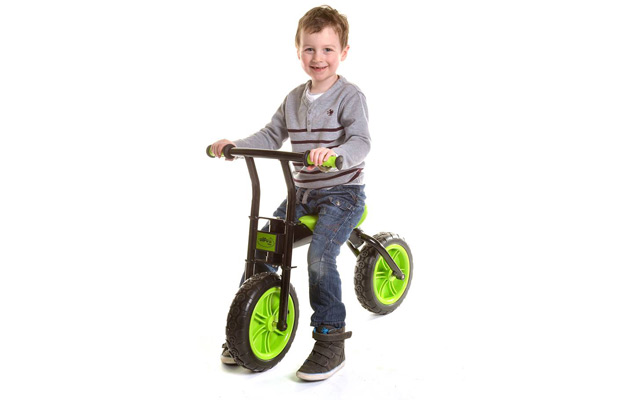
But this balance bike is good for flat roads where there are no bumps. The fact is that when the baby keeps his legs on the frame almost in front of him, his lower limbs are relaxed. And if the balance bike stumbles upon a bump, it is highly likely that the child will lose his balance and fall down.
How to choose a balance bike
It is better for a child to choose a balance bike with him! Take a closer look at the light modules first. Of course, if the baby is large enough, he will be able to handle a rather heavy balance bike, which weighs four kilograms. However, it would be more reliable to bring your child to the store and do what they say, field tests.
In order to attract your baby to ride a balance bike, it is recommended to choose models of attractive colors equipped with various bright accessories.
Usually these are horns, various toys, bells, musical elements. This will make riding a balance bike for a child a desirable and unforgettable experience.
Read also: Biking will save the world
To close the topic of balance bikes, let's say that this type of transport can be bought even for a child over three years old. Since the main task of this vehicle
is to teach the child to keep balance, such a balance bike will help in this matter, making it possible to overcome the fear of a two-wheeled bicycle.
Tricycle for children from one year old
A balance bike is good for riding on a flat road, rolling down a small hill. Moreover, under adult supervision. A much safer vehicle
for your baby is an ordinary tricycle (namely a tricycle, not a two-wheeled one with two additional wheels at the rear).
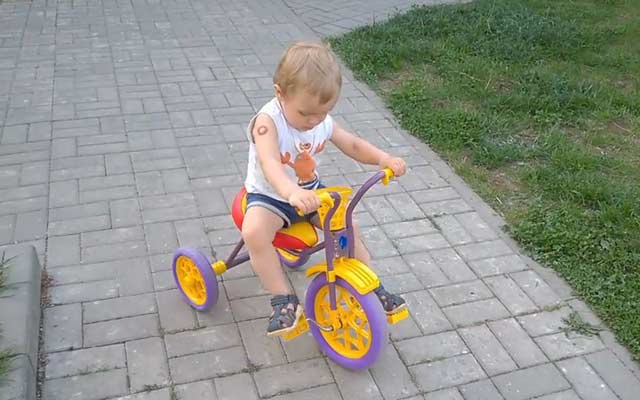
This type of transport, unlike a balance bike, will not give your child the opportunity to learn how to keep balance while driving. Usually parents buy it for the little ones as an alternative to a stroller.
Such bicycles often have a handle, and their pedals are located on the front wheel.
What is good about a tricycle for a baby from one year old
This bike will allow your child to learn how to pedal. At the same time, the child works with his legs, and does not sit passively, like in a stroller. There is no doubt that closer to two years old, the child will pedal so actively that you will only push the vehicle down the hill.
However, it is a pure convention to say that this bike is designed for children from one year old.
Initially, the baby will not keep his legs on the pedals, so choose models that have a footrest. It will be convenient for the little ones to put their feet on it until they can reach the pedals.
From a safety point of view, it is necessary that such bicycle models be equipped with a so-called parking brake (as in a regular stroller). It would be nice if the footrest was foldable or removable. As the baby grows up, it will be possible to clean it, which will force him to put his feet on the pedals.
Tricycle for children from 2 years old
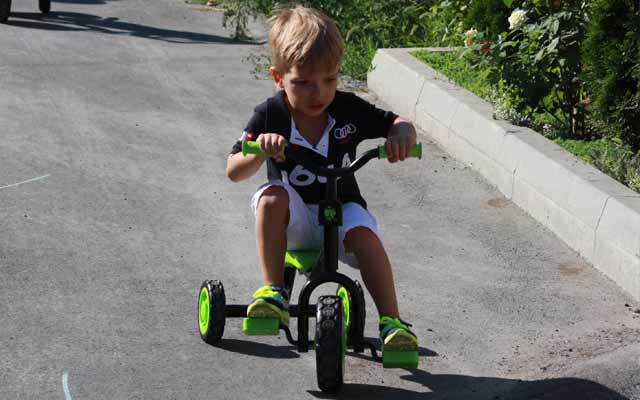
By about two years of age (plus or minus), a child can buy the simplest lightweight tricycle without a pusher handle so that your child can drive under your supervision in the yard or in the nursery site. If you had a bike with a pusher handle, you can remove it (if it's detachable, of course).
As standard, to make children feel comfortable, many manufacturers produce such bicycles with a front wheel with a diameter of 12 inches. The rear wheels usually have a smaller diameter of 10 inches. It is desirable that they be inflatable — again for a comfortable ride.
Why is it useful to ride a tricycle on your own
At the age of two, a child quickly gets tired of pedaling for a long time. However, it is at this age that it is useful to ride a simple tricycle, because the baby learns to choose the road and steer. In principle, this is also a kind of transition to a two-wheeled bike.
Usually tricycles for the little ones do not have brakes. And it is not needed – there is little strength in the baby's legs, so he will not be able to accelerate much (unless, of course, he lets the vehicle go down the hill, but who leaves the child unattended at this age?).
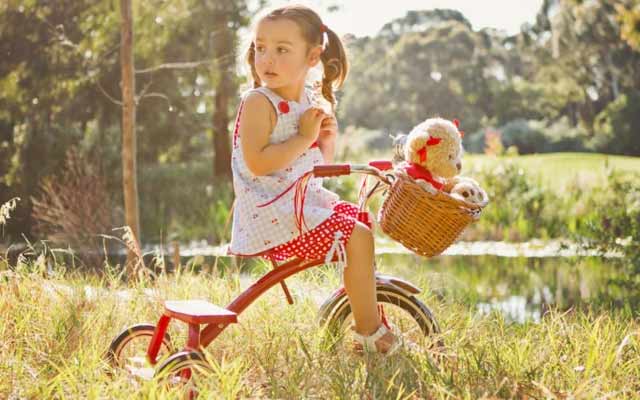
Do not be afraid if the baby does not have enough leg length to fully turn the pedals. Children at this age grow up quickly, which means that soon your child will feel quite comfortable working with legs. The main thing is that he can reach the ground with his legs (but not in a very bent state), sometimes helping himself to move such a bike like a balance bike.
The topic of cycling for babies under three years old can be closed with the following advice: if you have such an opportunity, try not to limit yourself to just a balance bike or just one three-wheeled bike. Periodically driving a baby on both vehicles will only benefit him.
Children's bicycles from 3 to 5 years
At the age of three (a little earlier or a little later — everything is individual here), a child can be transferred to a two-wheeled bicycle with two additional wheels that are attached to the rear feathers frame or to the rear wheel shaft, giving additional stability.
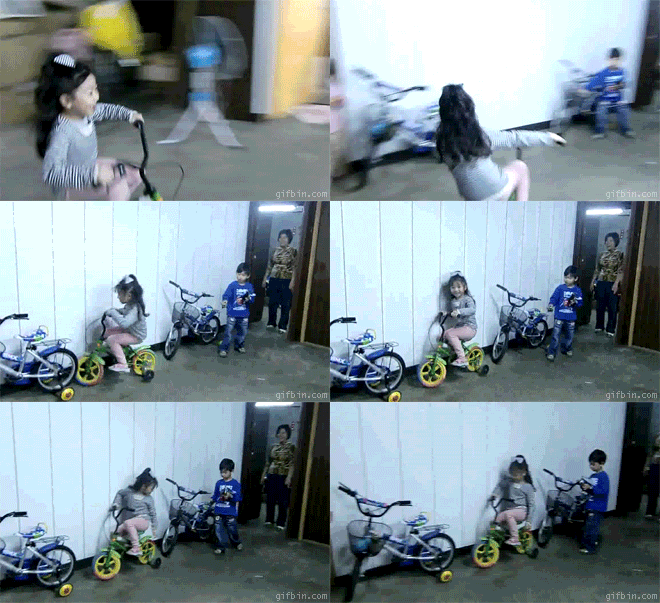
These bikes are already equipped with brakes. Most often it is a foot brake provided by turning the pedal backwards. However, manufacturers often duplicate many models with a hand brake. It makes sense to choose a bike with an aluminum frame rather than a steel one — it is quite durable, but lighter (although often more expensive).
Children's bike wheel diameter
One of the main questions that adults have is what diameter bicycle wheels for children should be. At this age (from three years), you can recommend wheels with a diameter of 12 inches. If the child is big and tall enough, or if the bike is purchased closer to 4 years old, the wheels can be 16 inches in diameter.
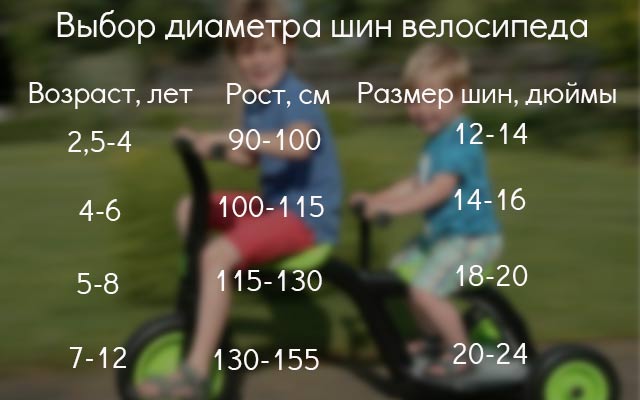
By the way, you can often see tables that, in theory, are designed to make it easier to choose a children's bike. According to these tables, the bike is chosen depending on the child's age and height. In particular, many people recommend the following selection criteria:
For an age of 2.5-4 years and a height of 90-100 cm, the tire diameter should be 12-14 inches;
For an age of 4-6 years and a height of 100-115 cm, the tire diameter should be 14-16 inches;
For an age of 5-8 years and a height of 115-130 cm, the tire diameter should be 18-20 inches;
For ages 7-12 and 130-155 cm in height, the tire diameter should be 20-24 inches.
These parameters are very approximate and do not take into account the individual physical characteristics of
each child. In fact, you should choose a bike individually. This is especially true for children aged three to five years.
At this age, it is definitely necessary to put the child on a bicycle and ask him to put his feet on the pedals. If your child's knees in the uppermost position of the pedals are almost at the height of the steering wheel, this means that the child has already outgrown this bike.
Ask the child sitting on the bike seat to put their feet to the ground. If he manages to reach the ground with both legs, while his legs are not particularly bent, and your child's butt is on the seat, then the height of the bike is chosen correctly.
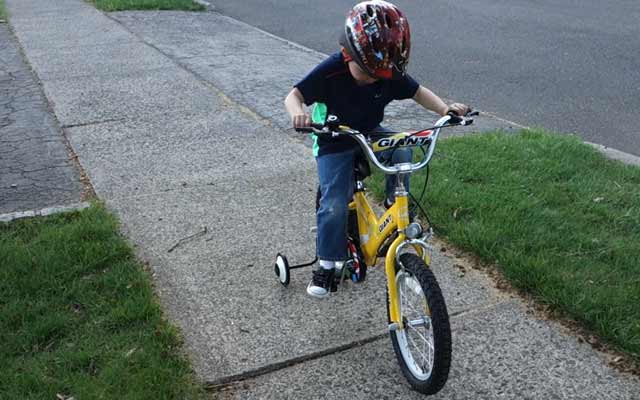
Next, ask your child to put their feet on the pedals. If the child's leg, which is in the lowest position on the pedal, is barely bent, it also means that this bike is suitable for your baby.
An important point:
such measurements should be carried out with the seat minimally lowered!
The fact is that almost all modern children's bicycles provide the ability to adjust the height of the seat and steering wheel. This means that your child, while continuing to grow, will be able to safely use this bike for a couple of years. Usually, for the age of 3-5, it is enough to buy a bicycle with one gear, although the market offers other options.
Additional wheels for children's bicycles
Some kids can ride a two-wheeled bike quite well at the age of three. However, don't rush to remove the rear safety wheels! Of course, parents are solely responsible, but from the point of view of child safety, these wheels are very useful.
But if your baby keeps a good balance, these wheels can be replaced with other, smaller wheels. When riding such a bike, they will hardly touch the road, but if the child suddenly loses his balance, these wheels will keep the vehicle and your child from falling.
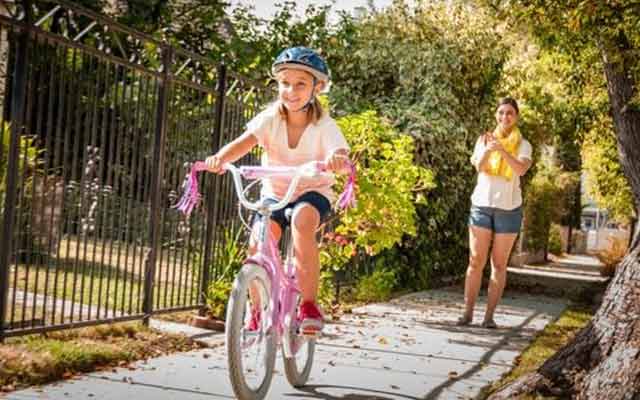
In fact, rear safety wheels are needed precisely to prevent the bike from falling, not to help it ride. Be that as it may, a trained child can be allowed to fully ride a full-fledged two-wheeled bicycle without safety wheels at the age of 5-6 (however, much is individual here).
Children's bicycles from 6 to 9 years
At the age of 5, an ordinary tricycle (with two full wheels, not safety rear wheels) is unlikely to be interesting and useful for a child who is great on a balance bike. This age period is remarkable because now, more than ever, you should choose a bicycle individually.
This is primarily reflected in the choice of wheel thickness — small, thin children aged 5 can ride on wheels with a diameter of 16 inches, and large and tall children aged 9 years can already ride on wheels can ride on 24-inch wheels.
At the same time, the bicycles themselves may well be equipped with rear safety wheels, although this is already rare (especially for 20-inch wheels), because such bicycles are already increasingly similar to adult models. It makes sense to choose this vehicle only with a child.
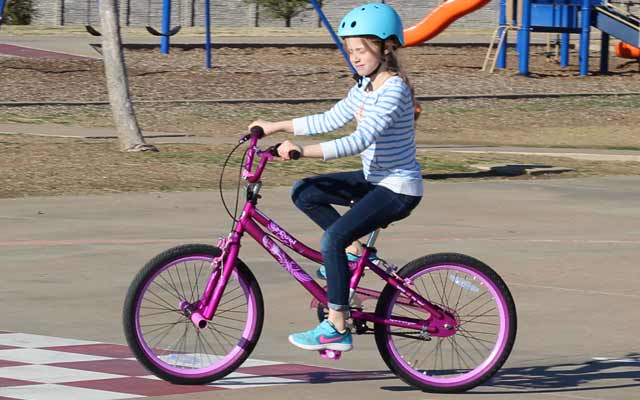
The selection criteria in this age range are slightly expanding:
– when the child jumps off the seat, the upper tube of the frame should not prevent him from standing;
– when the child is sitting on the seat, his foot on the pedal in the lowest position should be almost straight (but not completely);
– lower the seat all the way down. The legs of a child sitting on such a seat should touch the ground. This will allow him to hedge against falling in case of loss of balance (which is especially important due to the lack of safety wheels);
– the child, while on the seat, should not hunch too hard to reach the steering wheel;
– the child's knees in the uppermost positions of the pedals should be below the level of the steering wheel.
In this age range, interest in extreme skiing is beginning to appear, so you can choose models that have shock absorbers — rear and front. And if at the age of 6 a child can still be careful, then at the age of 9, with some driving experience, he will use his vehicle to the fullest.
That is why you should choose multi-speed bicycles.
Perhaps your child will not use this feature right away. However, once accustomed, the child will definitely change speeds, as a result it will be much easier for him to climb the hill or accelerate on a straight road.
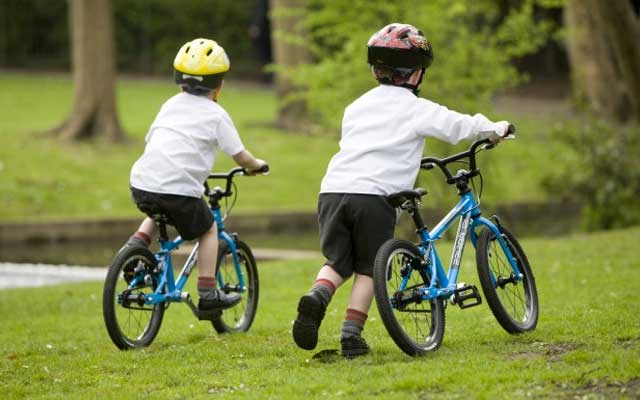
Child bike brakes
For children aged 6-9, bicycles can have both foot and hand brakes. However, in multi-speed bikes, the brake is usually manual. Moreover, bicycle models with rim brakes are most often produced. However, more expensive models may also include disc brakes.
Rim brakes are good because they do not make the design heavier and are easy to operate. Some people think disc brakes are superfluous for children's bicycles; they also make the bike a little heavier. However, the presence of such brakes increases the safety of driving on very dirty roads, which is important.
Make sure the bike is equipped with fenders (unless you plan to scrape dirt off your child's clothes). A very useful element of a children's bike is the footrest. This is not the kind of footrest that allows your baby to hold his feet on a balance bike. This element keeps the bicycle stationary while standing.
It is useful if the vehicle chain has a protective cover. This element is not designed to protect the chain from dirt, as many people think, but to prevent the child's leg from being screwed onto the chain. Finally, an important accessory, the importance of which is difficult to overestimate, is a horn or a bell.
Bikes for teenagers

At the age of 10, what is called early adolescence begins. It usually lasts up to 14 years (sometimes a little longer — everything is also individual here). And during this very period, the child stops “wearing out” his old children's bike, changing to a teenage model.
Teenage bicycle models no longer copy elements of adult bicycles. In fact, we are talking about smaller copies of adult bicycle models, among which there is also a clear division into simple road models, mountain models, as well as bicycles that allow take part in serious competitions.
Hybrid bike
So-called hybrid models that combine the functions of a mountain bike and a road bike are very popular. These bicycles are suitable for riding on rough and bumpy terrain due to their large wheel diameter (usually at least 28 inches), but they also behave much faster on the track than “clean” mountain bikes bicycle transport.
When choosing a bike for teenagers, pay attention to models with a more developed transmission; these bicycles are equipped with front wheel star block switches (located on the left handlebar) and the rear wheel star block (located on the right steering wheel handle).
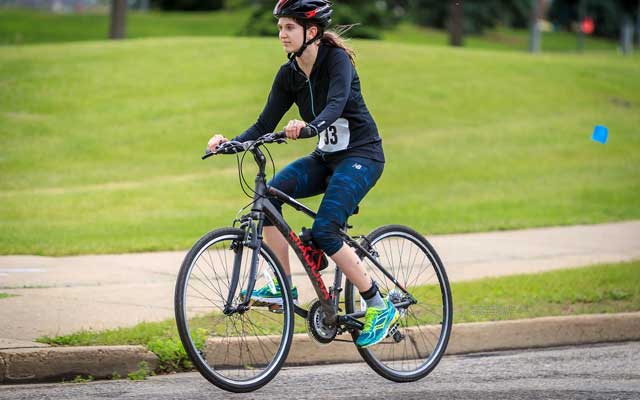
Such models will require certain driving skills and attentiveness from the cyclist, so they are more suitable for older children. However, at this age, bicycle models for children are practically the same as models for adults, so we will not dwell on them anymore.
Bike for boy and girl
The difference between bicycles for teenage boys and vehicles for teenage girls is that the upper tube of the frame for bicycles for girls is lowered (they are easier to ride in skirt). But there are also unisex bicycles, where the frame is not so low.
By the way: some adults, wanting to save money, buy a bicycle, as they say, for growth. The idea is clear — I want the bike to be used for several seasons. However, this is a completely wrong approach, as a bicycle is not a sleigh!
See also: Which sleds to choose: we buy a sleigh for a child
Firstly, the frame on such bicycles is high. If braked sharply, the child will slide off and hit it. Secondly, the child's legs do not reach the ground, and you have to lean heavily to the steering wheel. This is not only inconvenient for the child, but also unsafe for him.
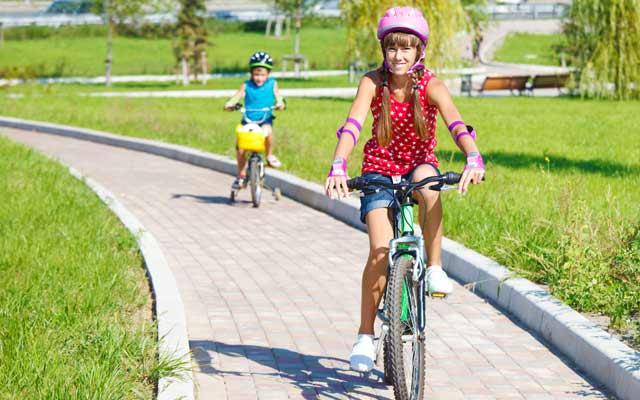
The most serious injuries threaten a child, of course, when falling off a bicycle. However, it is not uncommon for children to simply hit the frame. Therefore, the height of the frame is, in principle, an important criterion for choosing a bicycle for a teenager. When a teenager is standing, it is necessary that there be a distance of 4-5 centimeters between his groin area and the bicycle frame.
By the way, this is a reliable criterion for choosing a bicycle by height not only for teenagers, but also for adults. Do not forget about the height of the seat: when the seat is minimally lowered down, the teenager should touch the ground with his feet. This will also give him the opportunity to hedge against falling while he learns to ride a big bike.
Bicycle protection for a child
Bike helmet, gloves, knee pads, elbow pads — all these accessories are not at all luxury, as they are designed to ensure the safety of your child. Their main task is to make it safe to fall. Alas, it is extremely rare to do without falls. But it is through failures that our children learn to keep their bicycle safely on the road.
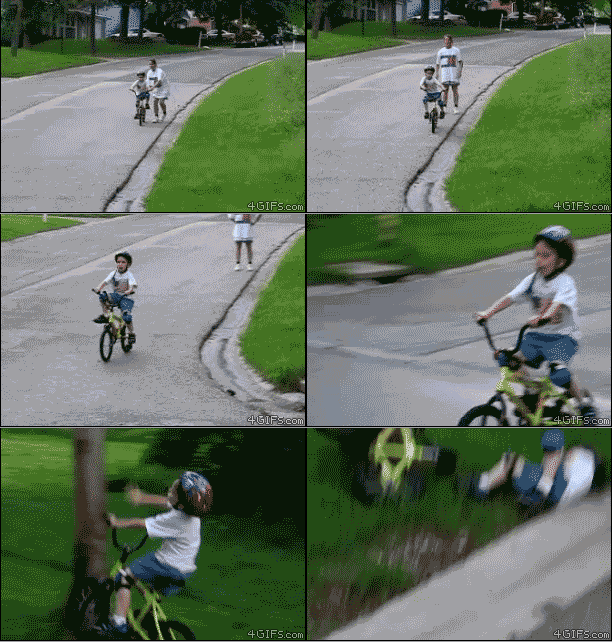
In conclusion, I would like to note that the choice of models and various bells and whistles for these models is limited not so much by parental imagination as by the parents' wallet budget. The modern market allows you to choose such advanced models that riding a bicycle can become a lifelong hobby for your child.