
 Ecology
Woolly mammoths have apparently become extinct for a number of reasons, including climate change, human extermination, and habitat change. Researchers believe that all these factors influenced the extinction of these amazing giant animals.
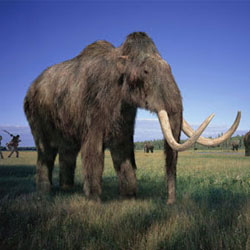
The woolly mammoth (Mammuthus primigenius) roamed our planet 250,000 years ago and was common in Europe and North America. Its coat was up to 50 centimeters long, and its powerful tusks could be up to 5 meters. Almost all mammoths disappeared from Siberia 10,000 years ago, although dwarf mammoths survived on Wrangel Island in the Arctic Ocean, where they became extinct much later, about 3,700 years ago.
Scientists have long debated what could have influenced the extinction of mammoths. For example, researchers have long believed that ancient tribes hunted mammoths and other Ice Age giants until they wiped them all out. Others believed that a meteorite impact on Earth could change North America's climate 12,900 years ago, causing large animals like mammoths to gradually disappear.
Today, an analysis of thousands of fossils, artifacts and thousand-year-old sites that have preserved unique conditions shows that not only one factor influenced the disappearance of woolly mammoths, the reasons were a few.
Mammoth database
Scientists have studied the extinction of woolly mammoths that lived in Beringia, where the last members of this species lived. Today, this area is home to the northeastern part of Russia and Alaska. Once these territories were connected by an isthmus, and later the land went under water. Scientists examined samples of more than 1,300 mammoths, about 450 tree specimens, explored 600 different archaeological sites and 650 peatlands to understand how the environment has changed and how it could influence mammoths. Scientists also took genetic data from mammoths from fossils.
“There will always be people talking about incomplete data that fossils provide, there will always be uncertainty, but our database has thousands of samples so it can It doesn't matter to give any general information,” says Glen MacDonald of the University of California, Los Angeles.
Studies have shown that woolly mammoths thrived in the open steppes of Beringia between 30,000 and 45,000 years ago, as these areas had enough food — grass and willow. These places were not as warm then as they are today, but not as cold as during the Ice Age. “These places were pretty good for mammoths, so their numbers were large,” McDonald said. At that time, people existed next to mammoths, but could not exterminate them all.
Later, during the coldest period between 20,000 and 25,000 years ago — the Last Glacial Maximum — woolly mammoth populations began to decline, probably because these areas were gone so favorable because of climate change. At that time, mammoths were doing great in the warmer regions of Siberia.
“There was an old idea that conditions as harsh as during the Last Glacial Maximum were optimal conditions for mammoths,” says McDonald. – Today, this idea is being heard unconvincing.”
Escape from the north
Mammoth populations began to replenish after the end of the Ice Age, but then began to fall back in the Late Dryas about 12,900 years ago. Although scientists are unable to agree on what happened at the time, many believe that “there was definitely a very rapid and significant cooling, which was followed by a sharp warming,” McDonald said. “Could this have led to the disappearance of mammoths? Definitely not! The animals still existed far north at the end of the Late Dryas period,” he added.
The last mammoths that existed on the planet were concentrated in the north. It is obvious that they disappeared about 10 thousand years ago with a warming climate, when peatlands, humid tundra and coniferous forests developed. Mammoths did not feel well in such an environment. The long and close proximity of mammoths to humans could lead to the fact that people destroyed these giants. It is possible that humans also caused the disappearance of the last mammoths on a remote northern island 3,700 years ago.
Thus, it can be concluded that mammoths have disappeared due to several important factors. These studies are important for understanding what might happen to animals that are on the verge of extinction today. Today we are witnessing very rapid climate change, habitats are changing dramatically, and humans are putting considerable pressure on living beings. Some modern species face exactly the same situation as mammoths did many years ago. Scientists believe that the scale of changes that are taking place today is much more serious than in the days of mammoths.
In the near future, scientists will be working on studies of animals that were once abundant in Beringia, such as horses and bison.